
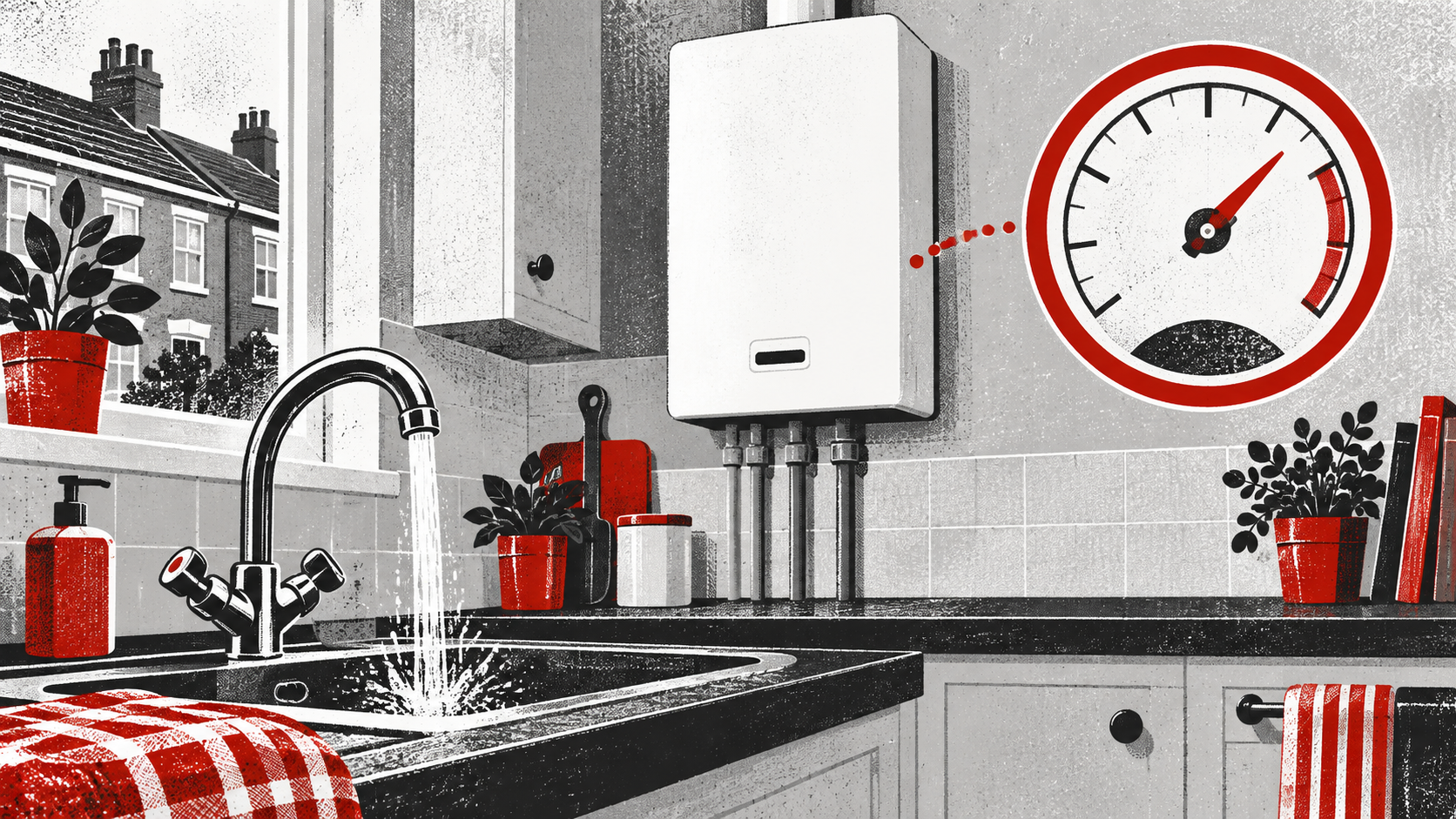
Why does the boiler pressure gauge rise when I run hot water?
On a combi boiler, opening a hot tap starts the boiler and warms part of its sealed primary circuit, so a modest temporary movement on the heating-pressure gauge can occur. The gauge should not climb dramatically, stay high after the boiler cools, or need repeated pressure corrections. Record the cold, running and cooled readings so an engineer can diagnose the pattern.
Do not remove the casing, operate internal valves or repeatedly top up and drain the system. Boiler pressure and tap-water pressure are related to different water circuits.
What the gauge is actually measuring
The boiler pressure gauge normally shows the pressure in the sealed central-heating circuit. It does not show how forcefully water comes out of the hot tap.
A combi boiler takes cold mains water and heats it on demand, but the sealed boiler water transfers the heat without mixing with the tap water. That is why the heating gauge can move when no radiator is being asked to heat.
A small rise can be normal
Water expands as it warms. The expansion vessel provides space for that change and helps keep pressure stable. Manufacturer guidance commonly expects some movement between a fully cool system and a hot operating system.
Worcester Bosch says a typical cool reading is around 1 to 1.5 bar and advises that a rise of more than 1 bar by the time the heating is hot may indicate that the expansion vessel needs attention. Your boiler’s own manual takes priority because acceptable readings vary.
Why a hot tap affects a combi boiler
Worcester Bosch explains that a combi provides both heating and hot water in one appliance and fires in response to a tap being opened. Internally, the appliance directs heat towards hot-water production.
Although the radiators may stay cool, water within the boiler’s sealed primary side heats during that process. A small gauge movement that settles again can therefore be an operating effect rather than proof of a fault.
How much movement is too much?
There is no single safe number for every model, but the change should be judged against the appliance instructions and its normal behaviour. A rapid climb towards the high-pressure or red area is different from a slight needle movement.
Arrange a check if the rise is repeatedly large, the reading continues rising after the tap closes, or the boiler discharges water outside. Do not wait for the pressure-relief valve to operate as a routine control.
Check the fully cold starting point
Pressure comparisons are meaningful only when they begin from a consistent state. Record the display or gauge after the heating has been off long enough for the system to become fully cool.
Do not top up simply to produce a preferred number. Follow the model’s user instructions, and seek help if the cold reading is outside its stated operating range or you are unsure.
Make one controlled observation
With the heating programme off, note the cold gauge reading. Run one hot tap at an ordinary washing flow for a few minutes, observe the highest reading without touching the boiler, then close the tap and record how the gauge settles.
Stop if the pressure rises rapidly, water appears, the boiler locks out or a fault code appears. One clear observation is more useful than repeated tests.
Does the reading return when the boiler cools?
A temporary rise should usually reduce as the water cools. If the gauge remains higher than its original cold value, water may be entering the sealed circuit or the gauge may need checking.
Photograph the gauge at the same angle each time and include the time. Analogue needles can be misread from the side, and some displays alternate between temperature and pressure.
The expansion vessel may need assessment
An expansion vessel contains a flexible separation between system water and a gas charge. If it cannot absorb the normal expansion effectively, the pressure can rise too far when the boiler heats and fall again as it cools.
Testing or recharging an internal vessel is not a household task. It may require the system to be isolated and depressurised, and the boiler casing may need to be removed.
A filling connection can also matter
The filling loop or filling link is used to add mains water to the sealed heating circuit. If a valve has been left open or is not closing properly, the pressure can rise even when heat expansion is not the main cause.
Do not operate an unfamiliar filling arrangement to test it. Tell the engineer whether the system was recently topped up and who did it.
What if pressure rises when the boiler is cold and off?
A cold system that gains pressure while the boiler is not firing is not explained by thermal expansion. Manufacturer fault-finding information separates this pattern from a rise that occurs only while the boiler is hot.
Possible routes for water to enter the sealed circuit need model-specific testing. Do not try to prove the cause by closing service valves beneath the boiler.
Look for evidence of discharge
If pressure becomes excessive, a safety valve may release water through a discharge pipe outside. From ground level, look for dripping or staining at the safe termination point, but do not climb or touch the pipe.
A discharge followed by low cold pressure can create a cycle of topping up, heating and losing water. Repeatedly refilling the system is not a repair and can introduce fresh oxygen into the heating water.
Could the gauge itself be misleading?
An analogue needle can stick, while a digital display may show system temperature until a button or menu changes the view. Check the symbols and units in the user manual.
If the displayed value jumps instantly rather than changing as the boiler warms, record a short video. The sensing or display needs to be tested rather than guessed at.
Stored hot-water systems are different
A system boiler or heat-only boiler may heat a separate cylinder. Its pressure behaviour depends on the primary heating circuit, cylinder controls and installation arrangement.
Do not operate cylinder safety valves or assume that a hot-water-cylinder pressure gauge represents the boiler’s heating pressure. Record which gauge moved and where it is fitted.
When to turn the boiler off and seek advice
Stop using the boiler and arrange prompt advice if pressure enters the appliance’s high or red zone, rises rapidly on every hot-water demand, water is discharging, a visible leak develops, or the boiler shows a fault or repeatedly locks out.
If you suspect the appliance is unsafe, HSE says not to use it until it has been checked. If you smell gas, call the National Gas Emergency Service on 0800 111 999 and follow its instructions.
What an engineer may check
An engineer can compare the cold and operating pressures, check the expansion vessel, pressure sensor or gauge, filling connection and safety-valve discharge, and test whether the heating and domestic-water circuits remain correctly separated.
Work inside a gas boiler must be carried out by an appropriately qualified Gas Safe registered engineer. Give them the readings and timings rather than attempting internal tests.
Common questions
Is any rise during hot-water use normal?
A modest temporary rise can occur on a combi because the boiler’s primary water heats during hot-water production. The model manual and size of the change matter.
Why does the gauge fall again after I close the tap?
The primary circuit is cooling and the water is contracting. A large swing or repeated loss below the correct cold range needs checking.
Does high tap pressure cause high boiler pressure?
Not directly. The tap water and sealed heating water are separate circuits, although a filling or internal crossover fault can allow mains water to affect the sealed side.
Should I bleed a radiator to reduce it?
Not as a repeated response. Removing water may lower the reading briefly without fixing why it rises, and hot water can scald. Arrange diagnosis of a recurring problem.
Related guides: Boiler pressure rises when the heating is off, Boiler pressure jumps up and down and Pressure rises then drops after cooling.
Pressure climbing with every hot tap?
Have the rise and return pattern diagnosed safely.