
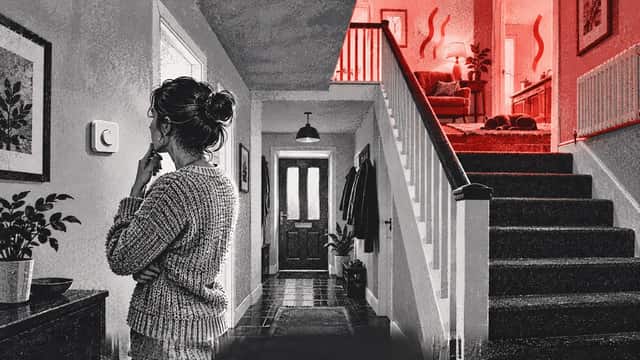
Why does the hall feel cold while upstairs rooms overheat?
A cold hall and overheated bedrooms usually mean the heating is not being shared evenly around the home. The hall may lose heat through the front door and external walls while warm air moves up the staircase. If the main thermostat is in that cooler hall, it can keep asking for heat after upstairs rooms are already comfortable.
This pattern does not automatically mean the boiler is too powerful or faulty. Thermostat position, radiator output, thermostatic radiator valve settings, system balance, draughts and the layout of the stairs can all contribute. A room-by-room record is the best starting point.
The short answer
Warm air is less dense than cold air, so it tends to rise and collect at the top of an open stairwell. At the same time, a hall commonly contains the front door, more air leakage and less usable wall space for a large radiator. The upstairs can therefore reach its target first while the hall remains below the temperature shown on the main thermostat.
A conventional room thermostat controls demand from the temperature where it is installed. It does not know that a bedroom is overheating. Thermostatic radiator valves can limit individual radiators, but they do not make a cold hall heat faster and they need to be set and used correctly.
Why halls are often the hardest space to heat
Entrance halls can have several disadvantages at once: an external door, a letterbox, glazing, a cold floor, frequent door opening and an open staircase. Heat loss can be high even though the hall is small. A narrow radiator may also have less output than radiators in upstairs rooms.
The staircase links two levels without a door. Warm air from the hall and nearby rooms can move upwards while cooler air returns lower down. This natural circulation can leave the landing and bedrooms warmer than the thermostat area.
How the hall thermostat can prolong heating
Energy Saving Trust explains that a room thermostat asks the heating to run until its own sensed temperature reaches the selected level. If the hall is the slowest space to warm, the demand continues. Upstairs radiators may keep receiving hot water unless their own valves reduce the flow.
The result can feel contradictory: the boiler and radiators are working, yet the place containing the control still feels cold. Raising the thermostat usually makes the upstairs overheating worse because it raises the point at which heating demand stops.
Start with a simple room-temperature map
- Choose a normal heating period and leave the usual target temperature unchanged.
- Record the hall thermostat reading and target when the heating starts.
- After 30 and 60 minutes, note the hall, landing and bedroom temperatures using the same household thermometer where practical.
- Record which radiators are hot, partly warm or cold and the position of each thermostatic radiator valve.
- Note whether bedroom doors are open and whether the front door has recently been used.
- Repeat on another comparable day before drawing a conclusion.
Household thermometers may differ, so look for a repeated pattern rather than treating one reading as exact. Do not change several valves and schedules during the test because that makes the cause harder to identify.
Check for an ordinary hall draught
A poor door seal or letterbox brush can cool the air near the thermostat. The effect is often stronger in windy weather and may be local enough that the rest of the hall feels less cold. Our guide to letterbox draughts and hall thermostats explains how to observe that pattern safely.
Ordinary door draught proofing can help, but never cover an air brick, trickle vent or fixed grille. Designed ventilation may be required for the building or an appliance. If you are unsure whether an opening is intentional, get competent advice before altering it.
Look at radiator output and obstructions
Make sure the hall radiator is not hidden behind a console, coat rack, curtain or decorative cover that restricts airflow. Furniture can reduce useful heat into the room even while the radiator itself feels hot. Keep the radiator and thermostat clear.
If the hall radiator is hot across most of its surface but the hall remains cold, its output may not match the heat loss. If it is consistently cooler than other radiators, the system may need balancing or a flow check. Worcester Bosch notes that uneven radiator heating can relate to circulation or system balance; the exact cause needs proper diagnosis.
Could sludge or trapped air be involved?
A radiator that is cold at the top may contain air. One that has persistent cold areas at the bottom can be affected by restricted circulation or deposits, although temperature by touch alone cannot prove sludge. Baxi lists cold spots and poor radiator performance among possible signs of system sludge.
Do not remove a radiator, open the boiler case or add chemicals without understanding the system. If several radiators behave unevenly, arrange a heating engineer’s assessment rather than treating one symptom in isolation.
Use thermostatic radiator valves carefully
Thermostatic radiator valves, or TRVs, sense the temperature close to each valve and reduce flow through that radiator as the room warms. Lowering upstairs TRVs slightly may reduce overheating, provided the valves move freely and the rooms remain comfortably heated.
Do not shut every upstairs radiator completely as a quick fix. Bedrooms still need adequate warmth, and major changes can hide a balance problem. The radiator in the room containing the main thermostat may not have a TRV, or may need a particular setting, because the two controls can otherwise work against each other. Follow the system designer’s and control manufacturer’s instructions.
Balancing is different from turning TRVs down
Hydraulic balancing adjusts how heating water is distributed so radiators warm at appropriate rates. It involves the lockshield side of the radiators and should be based on the actual system, not random quarter-turn adjustments.
Changing several lockshields without measurements can create new cold rooms, noise or poor boiler flow. If the hall consistently warms much more slowly than upstairs, ask a competent heating engineer to assess balance, pump operation, radiator sizing and control behaviour together.
Would zoning help?
Separate upstairs and downstairs zones can give better control where the two levels have different heat-loss and occupancy patterns. Energy Saving Trust describes zoning as using separate controls for different areas, while smart radiator controls can offer room-by-room scheduling on compatible systems.
Zoning is not just a software setting on every installation. It may require compatible valves, wiring, receivers or pipework and must be designed so the boiler always has suitable flow. A heating-controls professional should confirm what is appropriate.
Is the thermostat in the right place?
Manufacturer guidance generally calls for a representative location with free air movement, away from draughts, direct sunlight and local heat sources. A thermostat beside the front door, above a radiator or directly in the stairwell airflow may never represent the main living area well.
A portable wireless thermostat can sometimes be moved to an approved position using its proper stand, but it still needs the specified height and wireless range. Do not open or relocate a wired control yourself. Professional relocation may be the cleanest answer when the hall is structurally colder than the rest of the heating zone.
When the pattern needs prompt attention
Arrange an assessment if the hall cannot reach a reasonable temperature, bedrooms become excessively hot, radiators behave unpredictably, or the boiler runs for unusually long periods without achieving comfort. Seek prompt help where a baby, older person or someone with a health condition is affected by very cold or hot rooms.
If there is a gas smell, carbon monoxide alarm, water leak, scorching, unusual combustion-related noise or boiler fault, stop treating it as a room-balance question and follow the relevant emergency or manufacturer advice. Work inside a gas boiler must be completed by an appropriately qualified Gas Safe registered engineer.
Advice for landlords and tenants
Tenants should report temperatures by room, times, settings, door positions and radiator behaviour rather than simply saying the house is uneven. Include photographs of the thermostat, stair layout and any obstructed radiator without removing covers.
Landlords should consider the building fabric, radiator sizing, system balance and controls together. Do not ask a tenant to alter lockshields, move fixed controls or block ventilation. Record any professional changes and give clear instructions for the final settings.
The practical conclusion
A cold hall with overheated upstairs rooms is usually an imbalance between heat loss, heat movement and control location. The hall may be losing heat and feeding the stairwell while its thermostat continues to call for heat.
Map the temperatures, check ordinary draughts and obstructions, keep control settings stable and arrange a system assessment if the hall radiator or thermostat cannot represent the zone properly.
Hall cold while upstairs overheats?
Record the room temperatures and radiator pattern, then arrange a heating-controls assessment if the imbalance continues.