
Why has my property failed its gas tightness test this year when it was fine last year?
A pass last year is reassuring, but it is not a lifetime guarantee. Gas pipework and joints can change, and the industry procedure used by engineers changed in 2026. IGEM/UP/1B Edition 4 became effective on 1 October 2026, replacing Edition 3. Here is what that means in plain English.
What is a gas tightness test?
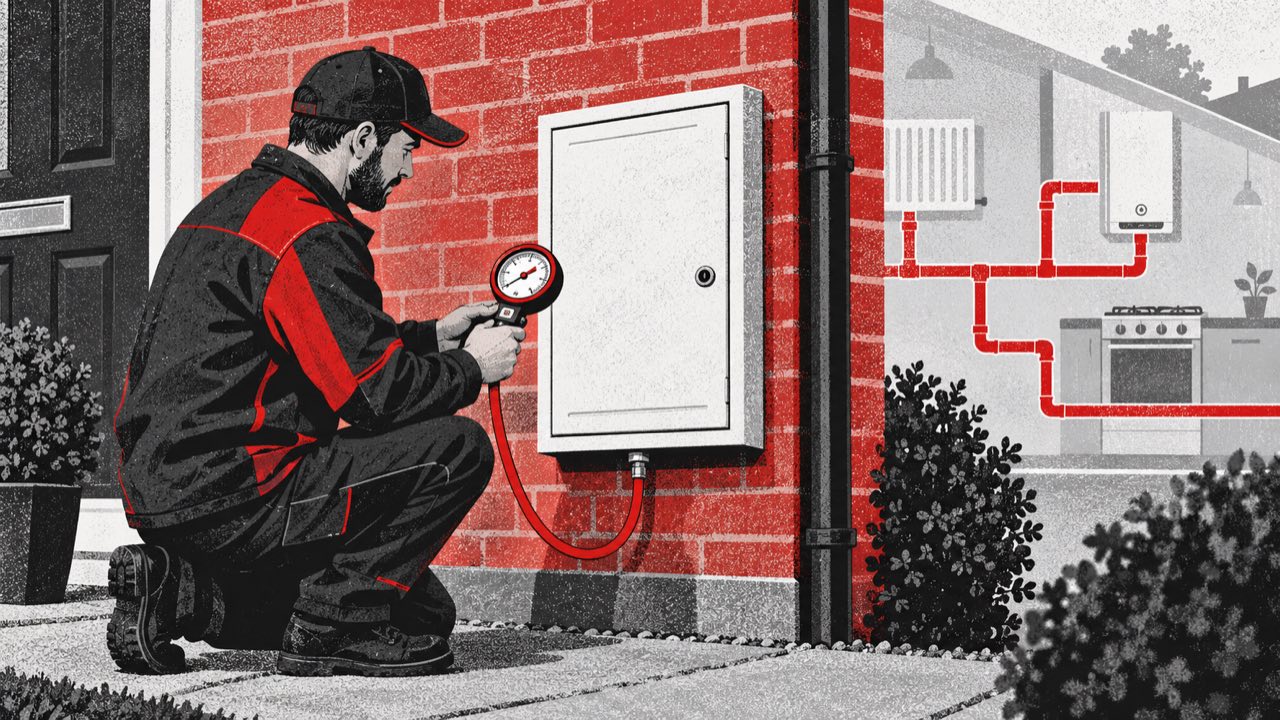
A gas tightness test checks whether gas is escaping from an installation. A Gas Safe registered engineer uses approved equipment at the meter and observes pressure under controlled conditions.
Think of inflating a bicycle tyre, closing the valve and watching a pressure gauge. If the pressure falls, something is allowing air out. A gas installation is more complicated because appliances may be connected, so the engineer must follow a formal procedure to distinguish the pipework from the appliances and decide whether the result passes.
It is not simply a visual inspection and it is not the same as checking that the boiler lights.
What changed in 2026?
The technical standard used for small domestic and similar installations was updated. IGEM published Edition 4 of IGEM/UP/1B in March 2026. Engineers were encouraged to adopt it as soon as reasonably practicable, and it became effective for everyone on 1 October 2026. Edition 3 was withdrawn on 30 September.
This is a change to the engineering procedure, not a new rule saying that every landlord must automatically order a separate full tightness test every year.
The current standard and its official FAQ make several points especially relevant to homeowners and landlords:
- Pressure movement has to be investigated. If movement is perceptible, the engineer must determine whether it comes from installation pipework or connected appliances.
- Pipework has to be proved tight. There is no permissible leakage allowance when proving the installation pipework itself is gas-tight.
- Appliances may need to be isolated and the pipework retested. This separates a pipework result from pressure movement associated with an existing appliance.
- If appliances cannot reasonably be isolated, the connected test must show no perceptible movement.
- Permissible pressure-loss limits depend on the fuel gas and installation volume. Where the observed loss needs assessment, the engineer may have to calculate that volume rather than apply a single figure to every property.
- Purging calculations have been clarified. Where purging is undertaken, installation volume must be calculated and purge volume determined as 1.5 times that volume, even in some cases where a volume calculation was not needed for the initial loss comparison.
These details are for trained operatives to apply. For the customer, the practical difference is that a result may be investigated, separated and recorded more carefully than before. A reading that somebody once treated as a small overall movement may now lead to appliance isolation and a separate pipework test before the installation can be accepted.
Does Edition 4 make every old installation fail?
No. It does not mean that all older pipework is suddenly unsafe. A sound installation can still pass. It does mean the current test and decision process must be followed, and a previous certificate cannot replace today’s result.
If an engineer says the procedure has changed, ask them to explain which part affects your installation: the observed movement, isolation of appliances, calculation of installation volume, or the distinction between pipework and appliance loss.
Why can a property pass one year and fail the next?
- A joint or fitting may have deteriorated. Seals, joints and valves can change with age.
- Pipework may have been disturbed. Flooring, kitchen or building work can affect hidden or exposed runs.
- An appliance may now contribute to pressure movement. Isolation and retesting may reveal the difference.
- The installation is being tested under the current procedure. Edition 4 may require the engineer to investigate and classify movement differently.
- Conditions are not identical. Meter arrangements, accessible isolation points and the part of the installation under test can affect the correct method.
A pass confirms the result at that time. It cannot guarantee that nothing will change later.
Is a tightness test required for every landlord gas-safety check?
No. The annual landlord gas-safety check and a gas tightness test are related but not identical.
Landlords must arrange annual checks for supplied gas appliances and flues, keep the required record and maintain gas pipework, appliances and flues safely. A separate full tightness test is not automatically required solely because the annual check is due.
However, an engineer must act if there is evidence or suspicion of a gas escape. HSE also recommends that installation pipework is inspected and tested for soundness before re-letting a property. The condition found, the work being undertaken and the current technical procedure determine what test is needed.
When is tightness testing required or clearly relevant?
Edition 4 applies to tightness testing in circumstances including:
- new installations;
- alteration, replacement, reuse or upgrading of an installation;
- new extensions to existing pipework;
- before and after work that may affect gas tightness;
- a known or suspected gas escape;
- complete loss of supply or installation pressure;
- routine testing of an existing installation; and
- immediately before purging, except when components are being permanently taken out of service.
The standard notes that it may not need to be applied for routine maintenance such as servicing. The competent engineer decides what is required in the actual circumstances.
What does a failed result mean?
It means the installation did not meet the required result under the test conditions. It does not automatically identify the defective fitting or section.
Where movement is detected, the engineer may need to isolate appliances and retest the installation pipework. If there is perceptible pressure loss on the pipework, IGEM says that is a failure and the pipework must be repaired or made safe.
If the pipework is proved tight, any remaining result with existing appliances connected is assessed against the applicable permissible limits and other conditions, including whether there is a smell of gas.
Can I look for or repair the leak myself?
No. Do not loosen fittings, remove appliance cases or use a flame to search for a leak. Gas work must be completed by a Gas Safe registered engineer competent for the work.
If you smell gas, open doors and windows if safe, turn off the gas at the emergency control valve if you can do so safely, avoid flames and electrical switches, and call the National Gas Emergency Service on 0800 111 999.
What repair options may follow?
- A targeted repair to an accessible faulty joint, valve or short section.
- Replacement of a damaged section where a local repair would not be reliable.
- Safe removal or isolation of an unused branch by the engineer.
- A replacement gas-line route where pipework is old, inaccessible, undersized or repeatedly troublesome.
The installation must be retested and commissioned correctly before it is returned to use. The correct option depends on where the defect is and the condition and accessibility of the pipework.
What should a landlord keep?
Keep the current gas-safety record, details of the failed test or defect, evidence of remedial work and the engineer’s final test documentation. A certificate from the previous year is not evidence that a newly identified problem can be ignored.
The important point
The major 2026 change is that Edition 4 is now the current procedure and gives clearer requirements for investigating perceptible movement, separating pipework from appliance results and calculating limits where necessary. A failure this year does not automatically prove last year’s test was wrong, but today’s result must be dealt with safely.
Need a clear diagnosis?
Book online and see exactly what is included in our fixed-price repair visit.