
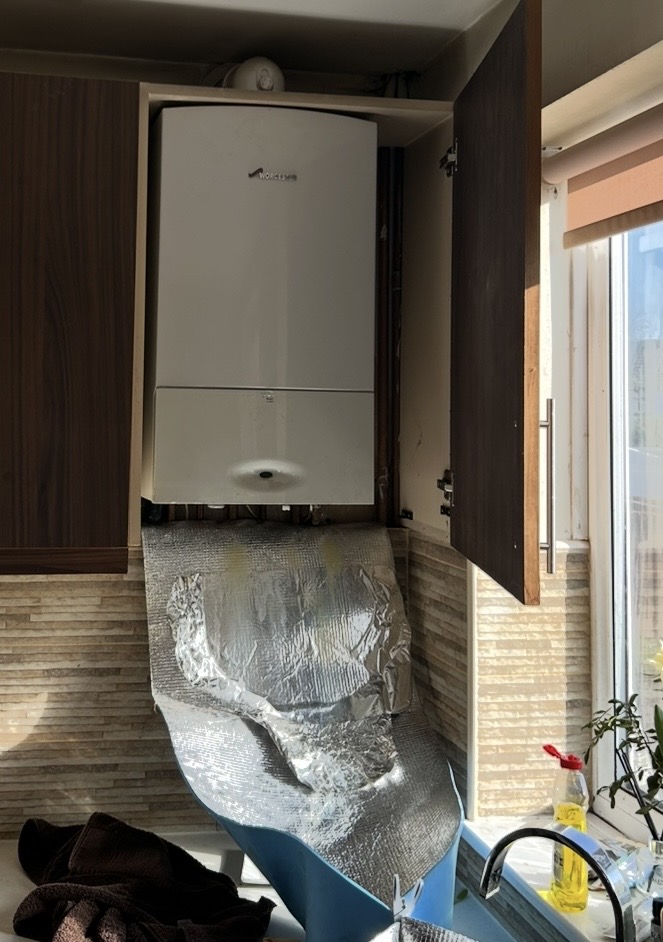
Water beneath a boiler should not be ignored, even if it is only a slow drip. It may be coming from an external pipe joint, a condensate connection, a safety discharge or a component inside the appliance. The puddle alone cannot identify the failed part. Protect the area, turn the heating off using its normal control and arrange a qualified inspection rather than removing the casing.
What to do immediately
- Keep clear of electricity. Do not touch wet plugs, switches or wiring. If water is reaching electrical equipment, keep away and seek urgent professional help.
- Turn the boiler and heating off at their ordinary user controls. Do not remove a panel to find another switch.
- Contain the water if safe. Use a bowl or towels without reaching beneath unstable pipework or touching hot surfaces.
- Photograph the leak. Record where the first visible drip appears, the pressure reading and any exact display code.
- Call a suitably qualified engineer. A leak from within a gas boiler requires a Gas Safe registered engineer competent for that appliance.
Worcester Bosch advises turning a leaking boiler off and arranging a Gas Safe registered engineer. Vaillant likewise treats a boiler leak as requiring specialist investigation and warns against opening the casing.
Is it definitely the boiler?
Water can travel along a pipe or cabinet before dropping from the lowest edge, so the place where it lands may not be the source. Check visually, without dismantling anything, whether the water begins at an accessible pipe joint below the boiler, a nearby washing-machine hose, the wall or ceiling above, or the boiler casing itself.
Condensation on cold pipework can also create moisture. Wipe an accessible external pipe dry and observe from a safe distance. Do not disturb a fitting to test it. A recurring drop, staining or falling boiler pressure supports the need for a leak investigation.
Clues the pressure gauge can provide
Record the pressure when the system is cool and again only if it is already operating normally. Compare it with the range in the exact boiler manual. A falling reading can accompany water loss. Regularly topping the system up may temporarily restore operation but does not repair the escape and can introduce fresh oxygen that encourages corrosion.
A pressure reading that rises excessively as the heating warms and then falls when cool can point an engineer towards an expansion or pressure-control problem. It does not prove which part has failed. Do not drain water or operate an unfamiliar filling loop to chase the needle.
Common categories of boiler leak
External pipe or joint
A compression fitting, service connection or nearby pipe may seep because of movement, corrosion, wear or an installation issue. If a new boiler leaks soon after installation, contact the installer promptly and preserve photographs. Do not tighten fittings beneath a boiler: some carry gas, some water and some may be hot.
Condensate pipe or trap
Modern condensing boilers deliberately produce condensate, which should leave through a dedicated pipe. A damaged, disconnected or blocked condensate route can place water where it should not be. Because the trap and internal connections are part of the appliance, diagnosis belongs with the engineer. Do not open the casing or pour chemicals into pipework.
Pressure-relief discharge
A sealed heating system has safety arrangements to release water if pressure becomes excessive. The discharge pipe often terminates outside. Worcester Bosch recommends checking for visible dripping at that termination when a system repeatedly loses pressure. Do not block, cap or redirect a safety discharge.
Worn seal or internal joint
Seals and joints can deteriorate with heat cycles and age. Water may then appear from the underside while pressure falls. Replacing internal seals requires the casing to be opened and the appliance checked afterwards, so it is not a household repair.
Corrosion
Corroded pipework or components can eventually perforate. Rust staining, green deposits on copper or repeated dirty water are useful observations, but the extent of damage may be hidden. An engineer must decide whether a local repair is sound or whether wider deterioration changes the economics.
Heat exchanger
A leaking heat exchanger is one possible and potentially costly cause, but water underneath a boiler does not prove it. Online diagnosis often jumps to the most expensive component. Proper testing is needed before discussing replacement.
Can you keep using a boiler that drips?
No general assurance is safe. A small visible drip can reach electrical parts, worsen suddenly or indicate pressure and corrosion problems. Turn the boiler off and obtain advice. If an engineer has already assessed a harmless external source and given specific temporary instructions, follow those instructions only.
Should you turn off the water?
If water is escaping rapidly and you know the location of the property’s mains stop tap, shutting the supply may reduce damage. However, not every heating-system leak will stop immediately because sealed circuits contain their own water. Do not operate unidentified valves under the boiler. If you are unsure, keep clear and seek emergency plumbing or heating help.
When it is an emergency
Call for urgent assistance when water approaches electrical equipment, the flow is rapid, a ceiling is bulging, the boiler makes alarming noises or anyone cannot safely contain the leak. Isolate electricity only at a dry, safe point and only if you know how.
Water leakage is different from a gas escape. If you smell gas or suspect an unsafe gas appliance, do not operate electrical switches or use a flame. Open doors and windows, turn off the gas at the meter if you know how and can do it safely, leave as directed, and call the National Gas Emergency Service on 0800 111 999. HSE gives the same emergency number for suspected gas or carbon-monoxide incidents.
If a carbon monoxide alarm sounds or people develop symptoms such as headache, dizziness, nausea or breathlessness, move into fresh air, seek urgent medical advice and do not reuse the appliance until it has been checked.
What the engineer will need to know
- the boiler make and exact model;
- where the first visible drop appears;
- whether it leaks only during heating, hot-water use or all the time;
- the cool pressure reading and whether it changes rapidly;
- any fault code or unusual noise;
- whether heating and hot water still work;
- whether the appliance was recently installed, serviced or repressurised; and
- whether water is also visible at radiators, pipe joints or the outside discharge.
These facts help separate an appliance leak from a wider system or building-water leak. Avoid stating that a specific part has failed unless it has been tested.
Repair or replacement?
Many leaks are repairable. The decision depends on the confirmed cause, the boiler’s age and condition, parts availability, warranty status and the cost of putting the appliance into dependable condition. A failed external joint is a different proposition from widespread corrosion or a major component failure.
Ask for the diagnosis and proposed work in writing. If replacement is recommended, ask why repair is uneconomic and whether other defects were found. Do not replace a boiler solely because a puddle was described online as a heat-exchanger failure.
Landlords and tenants
Tenants should report a boiler leak immediately, include photographs and say whether heating or hot water has stopped. Use the property’s emergency contact route where water or electrics are at risk. Do not remove the casing or commission unauthorised internal work.
Landlords and agents should arrange a prompt assessment, use a suitably qualified Gas Safe registered engineer for work involving the gas appliance, and record the report and repair. A current gas-safety record does not mean a new leak can wait until the next annual check.
Frequently asked questions
Why does the boiler leak only when heating is on?
Temperature and pressure rise as the system heats. That may expose a weak joint or pressure-control issue. Record the cool and warm readings but leave diagnosis to the engineer.
Why is the pressure dropping as well?
Water leaving a sealed heating circuit reduces its pressure. Repressurising repeatedly treats the reading, not the leak.
Could the water be normal condensate?
Condensate production is normal; condensate escaping into the room is not. It should travel through its intended drainage route.
Can I use leak-sealing chemicals?
Do not add chemicals based on guesswork. Compatibility, water condition, the leak location and manufacturer requirements matter, and sealant may mask rather than solve a defect.
Does home insurance cover the damage?
Policies differ. Photograph the area, reduce damage safely and contact the insurer promptly. Boiler repair cover and resulting water damage may be treated separately.
Useful next guides
- Why a boiler keeps losing pressure
- What should boiler pressure be?
- What happens during a boiler repair visit?
- Repair or replace an older boiler?