
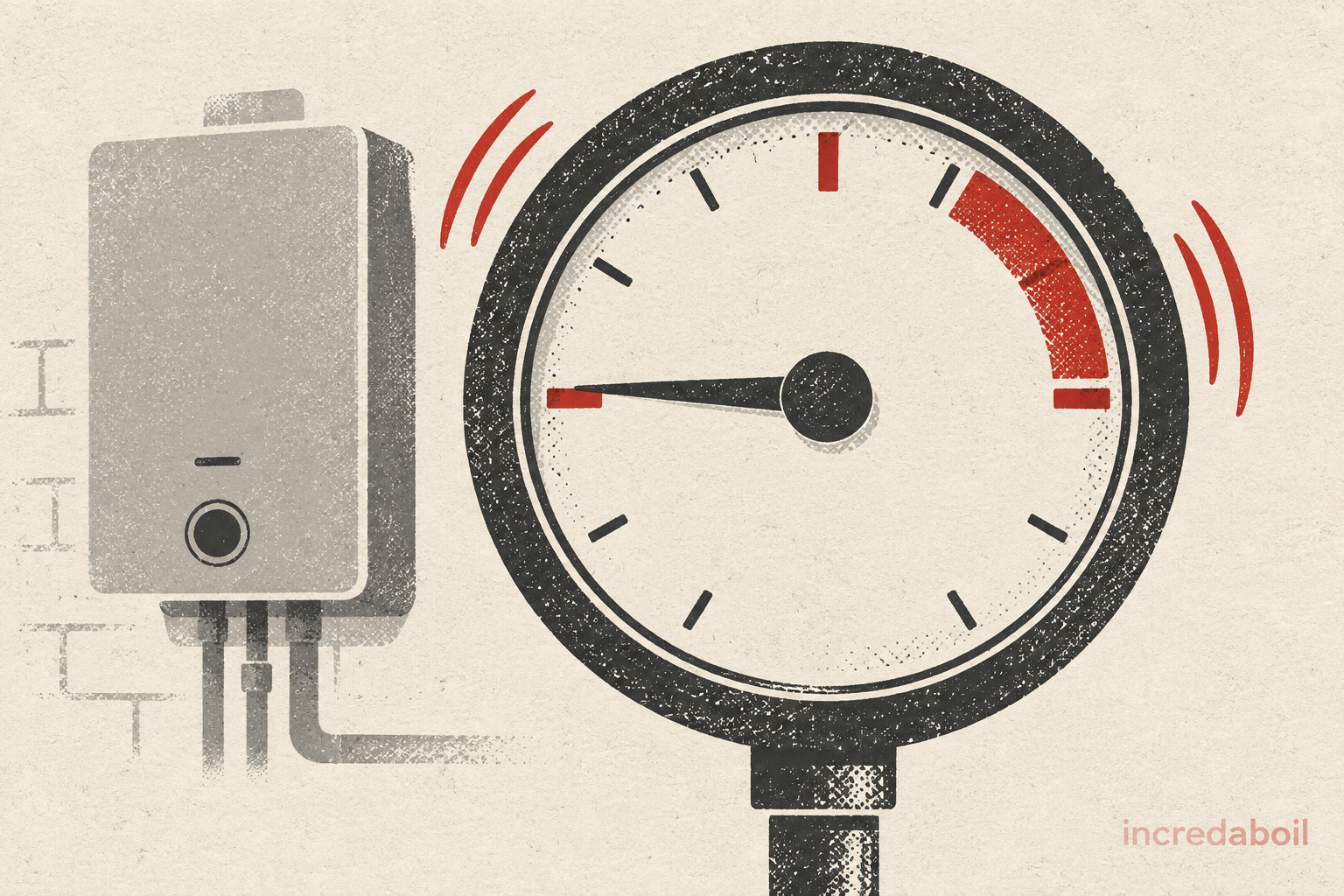
If a Worcester Bosch boiler pressure gauge is not moving, do not keep adding water simply to make the needle change. First establish whether the boiler is on a sealed system, whether the system is cold or hot, and whether the gauge is mechanical or a pressure reading on the display. A motionless reading can be normal on some open-vented systems, but on a sealed system it can also point to a stuck gauge, a closed filling control, a blockage or a pressure-sensing problem.
The safest approach is to compare what you see with the user instructions for the exact Worcester Bosch model. Record the cold reading, check it again after the heating has run, and stop if the pressure is already high, water is leaking or the filling arrangement is unclear.
What should a Worcester Bosch pressure gauge normally do?
On a typical sealed central-heating system, the gauge shows the pressure of the water circulating through the boiler and radiators. Worcester Bosch user instructions commonly describe a cold pressure of about 1 to 1.5 bar for relevant models. The reading normally rises a little as the system heats because the water expands, then falls again as it cools.
The precise normal range depends on the boiler and installation, so the shaded area or wording in the model manual takes priority. A gauge that moves modestly between cold and hot is behaving differently from one that stays fixed at exactly the same point through every condition.
First check whether you have a sealed or open-vented system
This distinction matters. Worcester Bosch documentation for some regular oil boilers explains that the pressure gauge is not used on an open-vented system, so its needle may remain at the bottom of the scale. An open-vented system normally has a small feed-and-expansion cistern, often in the loft.
Combi boilers and many system boilers use a sealed circuit, where the gauge should provide a meaningful reading. If you do not know which system you have, check the boiler manual or ask an engineer. Do not assume a zero reading means you should open a filling valve.
Why might the pressure gauge not move?
The system pressure is genuinely stable
A small temperature change may produce too little movement to notice on a compact analogue dial. Compare readings only when the system is fully cold and again after sustained heating. Take clear photographs from the same angle rather than relying on memory.
The boiler uses a digital pressure display
Some newer Greenstar models show pressure on the display as well as, or instead of, a traditional dial. Follow the user guide to find the correct status screen. Do not confuse a central-heating temperature figure with a pressure reading in bar.
The system is open vented
On a model and installation where the gauge is not used for operating pressure, a needle at the bottom may be expected. This is one reason generic online repressurising advice can be misleading.
The filling control is not admitting water
If the pressure is low and the gauge does not respond while you use the approved filling method, stop. The wrong control may have been identified, a valve may not be open, the filling link may be incorrectly fitted or there may be a restriction. Do not force a stiff valve or remove the boiler case.
The gauge or pressure-sensing path may be faulty
An analogue gauge can stick, and the narrow connection that allows it to sense system pressure can become restricted. A digital reading can also disagree with the real system pressure if the sensing arrangement has a fault. These are engineer checks, not homeowner repairs.
The system is empty or very low
A sealed system that has lost water may remain at or near zero. Look for visible drips, damp radiator valves, staining and water from the copper discharge pipe outside. Do not repeatedly refill a system that will not hold pressure.
Safe checks you can make without opening the boiler
- Identify the exact model. Use the name on the fascia or an accessible label and download the matching Worcester Bosch user instructions.
- Let the system cool. Note the pressure before the heating starts.
- Photograph the gauge. Take the picture straight on to avoid parallax error.
- Run the heating normally. If there are no warning signs or fault codes, compare the reading once the radiators are hot.
- Check for visible water. Look around accessible radiator valves, bleed points and pipe joints, without removing covers.
- Check the display. If the model provides a digital pressure value, compare it with the dial.
Stop immediately if there is a gas smell, a carbon-monoxide alarm, scorching, smoke, water near electrics or an active leak from the boiler. A pressure issue does not justify opening the combustion case.
Should you try to repressurise the boiler?
Only repressurise when the exact model instructions identify the homeowner filling control, the system is cool, and the pressure is below the stated range. Worcester Bosch uses several arrangements, including keyless filling links, keyed filling links and external filling hoses. The correct sequence is not interchangeable between boilers.
Introduce water slowly and watch the gauge continuously. Worcester Bosch homeowner guidance commonly tells users to stop around 1 to 1.5 bar for the covered systems, then close the controls fully. If the gauge does not move, stop rather than continuing to add water: the system pressure could be rising without the dial showing it.
What if the boiler works but the gauge stays still?
A working boiler does not prove the gauge is accurate. If a sealed system appears to heat normally but the needle never changes, arrange a check before relying on that gauge for future topping up. An inaccurate indication can lead to accidental overfilling or failure to notice pressure loss.
Keep a note of any fault code and whether the digital display shows pressure. Tell the engineer if the reading is fixed at zero, fixed in the normal range or fixed at a high value, as each pattern gives useful context.
A short written timeline also helps: note when the gauge was last known to move, whether the system was recently drained, and whether the apparent fault began after radiator bleeding or a loss of power.
What if the gauge is stuck on a high reading?
Do not add water. Allow the system to cool and recheck it. Worcester Bosch documentation for relevant sealed systems warns that persistent pressure above the normal operating range needs investigation; some model instructions state that a relief valve opens at about 3 bar.
If water is dripping from the external pressure-relief discharge pipe, do not block or cap it. Close any filling controls you have just used, keep clear of hot water and arrange professional help.
What if the pressure never rises when the heating comes on?
The usual hot-to-cold movement may be small, particularly in a modest system. But absolutely no change combined with other symptoms—fault codes, cold radiators, frequent topping up or disagreement between two readings—deserves investigation. Do not try to test the gauge by deliberately overfilling the system.
What information helps the engineer?
- The full Worcester Bosch model name.
- A photograph of the gauge when cold and another when hot.
- Any digital pressure value or fault code.
- Whether the pressure changed during an attempted top-up.
- Whether radiators were recently bled or plumbing work was completed.
- Any visible leak or outside discharge.
When should you book a repair?
Arrange a Gas Safe registered engineer when a sealed-system gauge remains fixed, the dial and digital reading disagree, the pressure will not respond to the approved filling method, the reading is unusually high, or pressure repeatedly falls. Internal gauges, sensors, hydraulic connections and safety components are not homeowner-serviceable parts.
Incredaboil offers fixed-price repair for eligible Worcester Bosch boilers. The engineer can determine whether the indication is wrong or whether the system pressure itself is abnormal.
Frequently asked questions
Can I tap the pressure gauge to free it?
No. Do not strike the boiler or gauge. A temporary needle movement would not confirm that the reading is accurate, and the cause still needs checking.
Why is the needle still on zero after topping up?
Stop filling. The system may not be accepting water, the wrong control may be in use, or the gauge may not be sensing the pressure. Continuing could over-pressurise the system.
Is 1 bar enough for a Worcester boiler?
Many Worcester Bosch guides show about 1 to 1.5 bar when cold for sealed systems. Use the range in the exact model instructions and consider the installation advice given by the engineer.
Does a fixed needle always mean a broken gauge?
No. The system may be open vented, the pressure may be stable, or the display may provide the main reading. Model and system type must be established first.
Related boiler-help guides
- What should boiler pressure be?
- Worcester Bosch boiler pressure drops overnight
- Boiler pressure gauge is stuck
- Boiler pressure relief pipe dripping outside
Worcester pressure gauge still refusing to move?
Book a fixed-price boiler repair so the gauge and sealed-system pressure can be checked safely.