
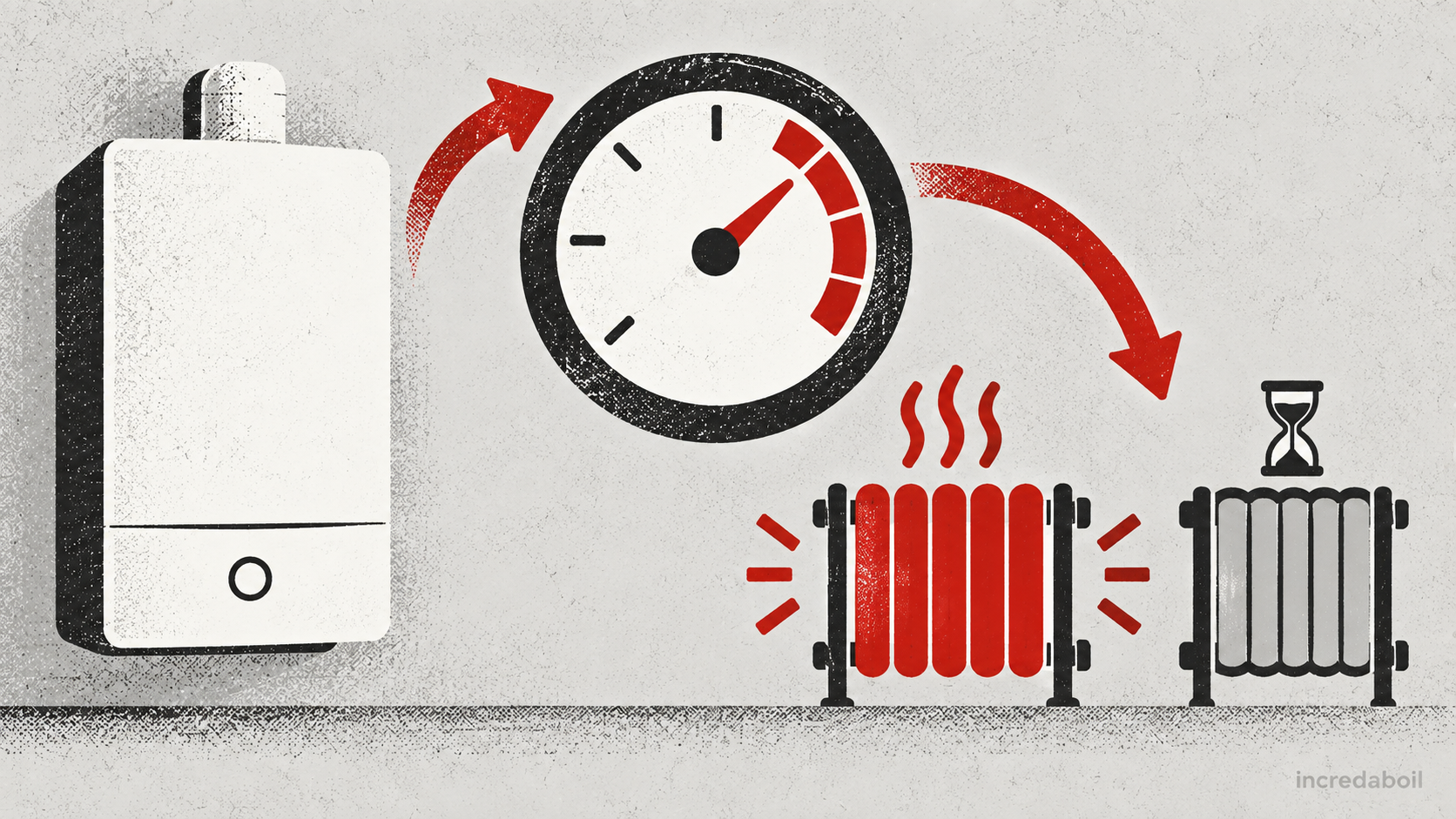
Worcester Bosch boiler pressure rises then drops when cool
A Worcester Bosch boiler’s pressure normally rises while the heating is hot and falls again as the system cools. Water expands when heated, and the sealed system is designed to accommodate that change. The important question is whether the gauge returns to a stable cold reading or finishes lower after every heating cycle.
A large hot rise followed by a low cold reading can indicate that the expansion vessel is no longer controlling the pressure correctly and that the pressure relief valve has discharged water. A steady fall can also come from a leak elsewhere in the heating circuit. The pattern is useful evidence, but it is not a safe DIY diagnosis of internal boiler parts.
How much pressure movement is normal?
Worcester Bosch says that when the heating system is cool, pressure should normally be between 1 and 1.5 bar. Its homeowner guidance also says that if pressure rises by more than 1 bar when the heating reaches temperature, the expansion vessel may need attention from a service engineer.
The exact user guide for the model takes priority. Gauge markings, display symbols and filling arrangements vary across Greenstar and older Worcester ranges. Compare readings only under similar conditions: fully cool, fully warm and fully cool again.
The difference between a normal fall and a fault pattern
Normal pressure movement is repeatable. The gauge starts in the model’s normal cold range, rises moderately during heating and returns close to its original reading after the radiators and pipework cool.
A fault pattern is different. The pressure may climb rapidly towards the high end of the gauge, then return below its starting point. You may need to add water repeatedly, or you may find moisture at a radiator valve, pipe joint or the external discharge pipe. The boiler may eventually stop because the cold pressure is too low.
Record three readings before topping up
- With the heating fully cool, photograph the gauge or display and note the time.
- Run the heating normally until the radiators are warm, then record the highest visible pressure.
- Turn the heating off and record the reading again only after the system has cooled fully.
Repeat the observation on another day if the boiler remains within its normal range and there are no safety concerns. Do not deliberately drive the pressure high. A clear cold–hot–cold sequence is much more useful to an engineer than a single reading taken at an unknown temperature.
Why the expansion vessel matters
A sealed heating system contains an expansion vessel with a flexible separation between system water and a pressurised air side. It provides space for the water’s extra volume as it heats. If the air charge is lost, the vessel is damaged or the vessel is too small for the system, pressure can rise much more than expected.
That does not mean a homeowner should test, recharge or replace it. The vessel is connected to the boiler’s sealed heating circuit and may be inside the casing. Worcester’s own pressure guidance directs this work to a service engineer.
How the pressure relief valve can create the hot-then-low pattern
The pressure relief valve is a safety device. If system pressure becomes excessive, it can release water through a discharge pipe. Once water has left the sealed circuit, the gauge can be low when everything cools again.
From outside, look only for signs of recent water at the termination of the discharge pipe, if it is safely visible from ground level. Never block, cap or redirect that pipe. Do not operate the valve to “test” it: disturbing it can leave it dripping and it is not a homeowner control.
Other reasons the cold pressure may keep falling
A small leak can lose enough water to affect the gauge without creating a dramatic puddle. Check accessible radiator valves, visible pipe joints and the area beneath the boiler for staining, dampness or corrosion. Water can evaporate from a hot fitting, leaving a pale or rusty deposit rather than a wet patch.
Air released from radiators also reduces system pressure. If radiators were recently bled, one small adjustment may be expected, but repeated pressure loss means the reason for the air or water loss needs investigation. A faulty gauge or pressure sensor is another possibility when the reading behaves implausibly.
Could the filling loop be involved?
A filling arrangement that has been left open can cause pressure to rise even when the boiler is cold. That is a different pattern from pressure that rises mainly with heating temperature. Worcester has several filling designs, so use only the instructions for the exact model and installation.
Do not force valves or copy a video for a different boiler. If pressure continues rising while the system is off and cool, turn the heating off and arrange professional advice promptly.
When topping up is reasonable
Only add water if the exact Worcester user guide identifies the controls and gives a user procedure that you understand. Fill only to the stated cold pressure and close the controls exactly as described. Do not use a hot reading as the target.
Worcester says a system would usually need topping up only once or twice a year. Needing it much more frequently is a reason to contact the installer. Continual refilling does not repair the cause and introduces fresh, oxygenated water that is undesirable for the heating system.
What not to do
- Do not remove the boiler casing.
- Do not recharge an internal expansion vessel yourself.
- Do not repeatedly refill a system that is losing pressure.
- Do not operate or block the pressure relief valve.
- Do not bleed radiators simply to bring down every normal hot pressure rise.
- Do not assume a dry floor rules out a leak.
When to stop using the boiler
Turn the boiler off and obtain advice if the pressure enters the high red area, water is escaping from the boiler, a discharge pipe is running continuously, or the display reports an overpressure or low-pressure fault. Isolate electrical power only if it is safe and there is water near electrical parts.
If you smell gas or suspect an unsafe appliance, HSE says to turn it off, avoid using it and have it checked by a Gas Safe registered engineer. For a suspected gas leak, open doors and windows, avoid flames and electrical switches, leave if necessary and call the National Gas Emergency Service on 0800 111 999.
What an engineer will need to know
- the full Worcester Bosch model name;
- cold, hot and cooled-again readings;
- how quickly the pressure changes;
- whether topping up has become more frequent;
- whether radiators were recently bled;
- any visible leaks or discharge outside; and
- the exact fault code, if one appears.
An engineer can then check the expansion vessel, relief valve, gauge or sensor, filling arrangement and heating circuit with the correct instruments. Any work inside a gas boiler must be done by a suitably qualified Gas Safe registered engineer.
Why the timing of the drop matters
Pressure that falls only after several hours of cooling is different from a gauge that collapses as soon as the burner stops. A gradual overnight fall can reveal a small water loss that is hard to see while pipes are hot. A rapid fall after an unusually high peak makes discharge through the safety valve more relevant. Pressure that changes while the boiler is completely off and cold may instead draw attention to a leak, filling arrangement or unreliable indication.
Write down how long each change takes rather than trying to interpret it yourself. Also note whether the same pattern appears with hot-water use alone on a combi or only during central heating. That history helps the engineer reproduce the symptom efficiently without turning an observation into an unsafe repair attempt.
Frequently asked questions
Should boiler pressure rise when the heating is on?
Yes. Some rise is normal because system water expands as it heats. Worcester says a rise of more than 1 bar at operating temperature can indicate that the expansion vessel needs professional attention.
Why is the pressure fine when hot but low the next morning?
The hot reading may be masking a loss of water. If pressure rises excessively, the relief valve may discharge and leave a lower reading after cooling. A separate leak can create a similar result.
Can I keep topping up?
No. One correctly performed top-up may restore a low system, but frequent refilling is evidence of a fault or leak that should be investigated.
Does a pressure drop always mean the boiler itself is leaking?
No. The leak may be at a radiator, valve, visible pipe, underfloor pipework or external discharge. The gauge or pressure sensor can also be wrong.
Should I bleed a radiator to lower hot pressure?
Not as a routine response to normal thermal expansion. Bleeding removes water and can leave the cold system under-pressurised. Follow the model guide or an engineer’s advice.
Related boiler help
Does the pressure keep ending lower after each heating cycle?
Review the repair service details and arrange a professional pressure-system diagnosis.