
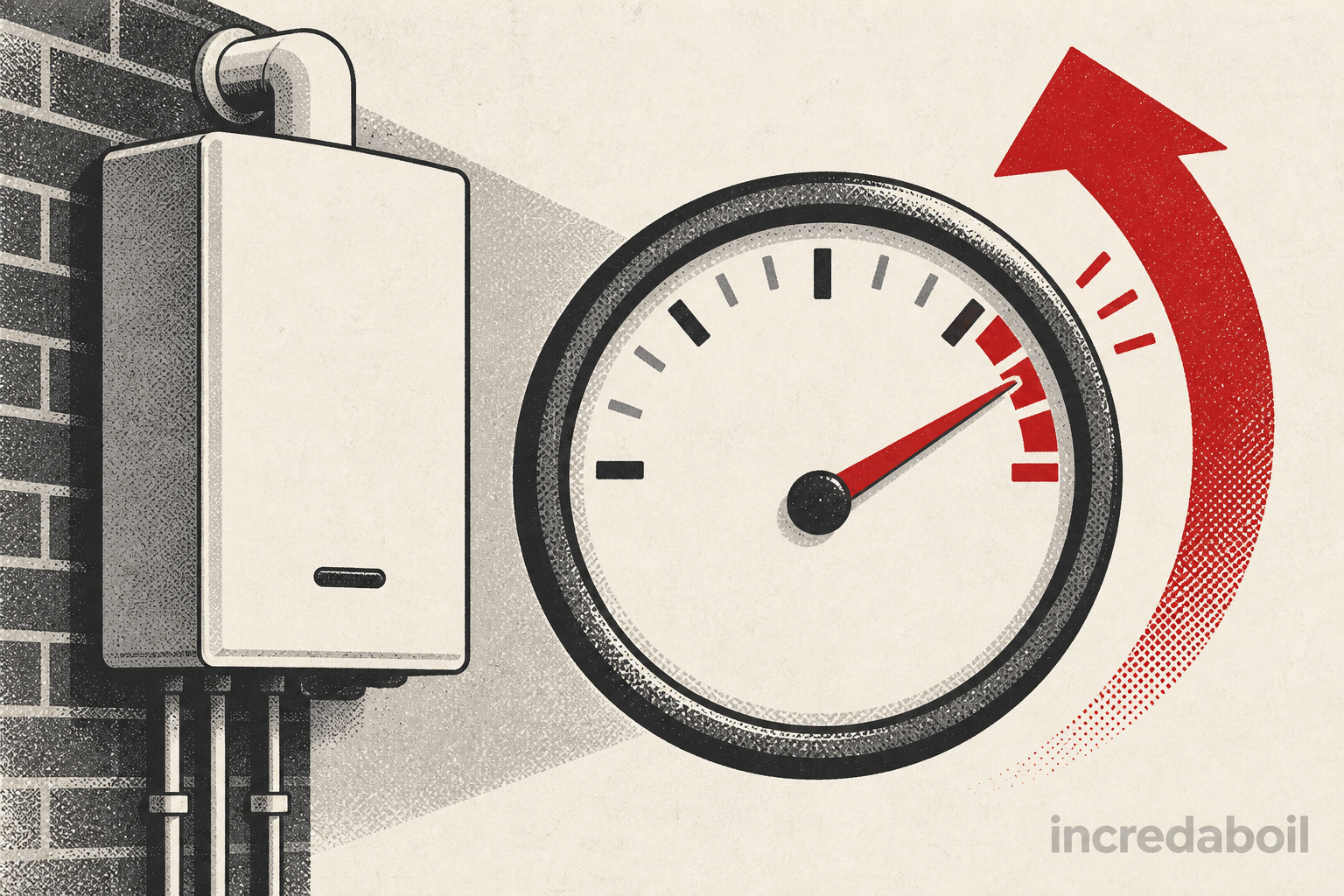
A boiler pressure gauge that climbs towards 3 bar whenever the heating comes on is not behaving normally. A small rise as the system warms is expected, but a large jump often means the heated water is no longer being accommodated properly. The usual suspects are an expansion-vessel problem, an overfilled system or a filling loop that is not fully closed.
This guide explains what the reading means, what you can check without opening the boiler, and when to stop and book an engineer. It applies to sealed central-heating systems, including many Baxi, Worcester Bosch and Ideal boilers. Always follow the user instructions for your exact model.
Is 3 bar too high for a boiler?
For most domestic sealed heating systems, yes. Baxi says the normal operating range is generally between 1 and 2 bar and that the needle should not rise above about 2.5 bar while the boiler is heating. Worcester Bosch says a cool system is normally around 1 to 1.5 bar, with the high red area beginning at roughly 2.75 bar on the gauges it describes.
Many boilers have a pressure-relief valve set to open at around 3 bar. That valve is a safety device: it can discharge water through a pipe that normally terminates outside. It should not be treated as a routine way of controlling pressure.
If your gauge briefly moves a little as the radiators warm, that is normal thermal expansion. If it travels from a sensible cold reading to close to 3 bar, enters the red zone, releases water or causes the boiler to lock out, the system needs attention.
What to do now
- Turn the heating off. Let the boiler and radiators cool before judging the cold pressure or touching a radiator bleed valve.
- Do not add more water. Repressurising a system that is already high will make the problem worse.
- Check the filling controls are fully closed. Look only at the accessible filling loop or model-specific filling control described in your user manual. Do not remove the boiler case.
- Read the pressure again when cold. Note both the cold figure and the highest figure reached during the next heating cycle, but do not keep running the system if it approaches 3 bar or discharges water.
- Look outside for discharge. Without touching it, check whether the small copper pressure-relief pipe is dripping or has left wet marks. Keep clear if hot water or steam is coming from it.
If the pressure is at or near 3 bar now, the boiler is leaking, the relief pipe is discharging, or you are unsure which control is the filling loop, switch the heating off and arrange professional help.
Why pressure rises when the heating comes on
Water expands as it heats. In a sealed system, an expansion vessel provides a cushion of compressed gas that accepts this extra volume. When the system cools again, the pressure should fall towards its original reading.
A modest movement is expected. Worcester Bosch advises that a rise of more than 1 bar as the system reaches temperature can indicate that the expansion vessel needs attention. Manufacturer service literature also links pressure that moves into the high zone specifically while heating with the expansion vessel’s charge, condition or capacity.
Checking or recharging an expansion vessel is not a homeowner job. It involves appliance-side diagnosis and may require depressurising the heating circuit. A Gas Safe registered engineer should test the system and identify the cause rather than simply releasing water.
The most likely causes
1. The expansion vessel has lost its charge or failed
This is a common pattern when the boiler sits around 1 bar while cold but climbs steeply as the radiators heat. With too little usable air cushion, the expanding water has nowhere suitable to go, so the gauge rises rapidly. Pressure may then fall very low again after the system cools, especially if the relief valve has discharged- theres less water in the system.
An engineer may test the vessel, recharge it where appropriate, check its internal diaphragm and confirm that it is large enough for the water volume in the system. Larger homes, extensions and added radiators can sometimes require additional expansion capacity.
2. The system was overfilled
If the cold reading started too high after topping up, radiator work or maintenance, normal expansion can push it towards 3 bar. Compare the cold reading with the band stated in the exact boiler manual. Do not assume every model should be filled to the same figure.
Baxi’s homeowner guidance says high pressure can follow overfilling and advises reducing it only with the heating switched off and the radiators cool. If you know how to bleed a radiator safely, releasing a small amount of water can lower an overfilled cold system. Protect the floor, open the bleed valve gently, keep watching the gauge and close it securely. Stop if the valve is damaged, seized or leaks.
Do not use radiator bleeding to mask a pressure rise that returns on every heating cycle. That recurring pattern needs diagnosis.
3. The filling loop is passing water
A filling-loop valve that has been left open, is not fully seated or is faulty can allow mains water into the heating circuit. This may make pressure increase even while the boiler is cold and switched off. Make sure the accessible controls are in the closed position shown in the user manual. Never force a stiff valve or dismantle a filling device.
A useful clue is timing: pressure that rises only as the system heats points more strongly towards expansion; pressure that continues creeping upward while everything is cold can point towards water entering through a filling arrangement or another internal fault. That distinction is helpful, but it is not a complete diagnosis.
4. The pressure-relief valve has discharged
The relief valve may open when pressure becomes excessive. Once operated, debris or damage can sometimes prevent it from sealing properly, leaving a persistent drip and low pressure after cooling. Baxi explains that a dripping relief discharge combined with low pressure needs a Gas Safe registered engineer to inspect the valve.
Do not cap, plug or obstruct the discharge pipe. It exists to release pressure safely.
5. The gauge or pressure sensor is inaccurate
If the display reading jumps erratically, disagrees with a separate gauge, or does not respond as expected, the gauge or sensor may be faulty. This requires proper testing. Do not assume the pressure is safe simply because the heating still works.
Cold pressure versus hot pressure
Always compare like with like. A reading taken just after the heating has been running will be higher than one taken after the system has cooled. Record the cold pressure first, then the highest hot reading if it is safe to observe another cycle.
- High when cold and higher when hot: the system may be overfilled, or water may be entering through the filling arrangement.
- Normal when cold but close to 3 bar when hot: an expansion-vessel or system-capacity problem is more likely.
- High when hot, then very low when cold: the relief valve may have discharged as pressure rose.
- Pressure rises even with the boiler cold and off: stop topping up and arrange a check of the filling controls and appliance.
These patterns help an engineer narrow the search. They do not replace a test of the sealed system.
Can I keep using the boiler?
Do not continue running it if the gauge reaches the high red area, approaches 3 bar, water is discharging, a fault code appears, or the pressure rise repeats. Switch the heating off and seek advice. A one-off slightly high cold reading caused by known overfilling may be correctable by safely bleeding a cool radiator, but a large temperature-related rise should be investigated.
If you smell gas, suspect fumes or a carbon-monoxide alarm sounds, do not investigate the pressure problem. Turn off the appliance only if it is safe, ventilate, leave the property and follow the emergency instructions from the Gas Safe Register and the National Gas Emergency Service.
Baxi, Worcester Bosch and Ideal boilers
The underlying sealed-system principle is similar, but the normal display, filling arrangement and user controls differ by model.
Baxi
Baxi’s current homeowner advice gives 1 to 2 bar as the normal operating range and says the reading should generally remain below about 2.5 bar while heating. It identifies overfilling and a filling loop that is not completely closed as common reasons for high pressure. If pressure stays high after a sensible homeowner check, Baxi directs customers to a heating engineer or its support team.
Worcester Bosch
Worcester Bosch describes around 1 to 1.5 bar when cool and says a rise of more than 1 bar at operating temperature may mean the expansion vessel requires repressurising by a service engineer. Worcester’s professional diagnostic information also distinguishes pressure that rises only when heating from pressure that rises continuously while the appliance is off.
Ideal
Ideal Logic user instructions tell homeowners to fill to the model’s stated cold range, commonly 1 to 1.5 bar in the cited Logic Combi2 guide. Ideal installation literature shows a 3 bar pressure-relief setting and explains that the expansion vessel must be appropriately sized for the system. Those servicing checks are for qualified professionals, not householders.
Use the full model name from the data badge or paperwork to find the correct manual. Do not rely on a fault-code list for a different generation.
What not to do
- Do not keep topping up a system with a high or rapidly rising gauge.
- Do not repeatedly bleed water away every time the heating runs.
- Do not operate the pressure-relief valve as a DIY drain control.
- Do not block a dripping outside discharge pipe.
- Do not remove a screwed boiler casing or try to recharge the expansion vessel yourself.
- Do not keep resetting a boiler that returns to a high-pressure fault.
Gas Safe Register guidance explains that an integral appliance case forming part of the combustion circuit should not be removed by a consumer. If reaching the part would involve undoing the boiler case, stop.
What to tell the engineer
A few accurate observations can shorten the diagnosis. Note:
- the exact boiler make and model;
- the pressure when fully cold;
- the maximum pressure reached while heating;
- whether it rises only when hot or also creeps up while cold;
- whether the filling loop was recently used;
- whether radiators or pipework were recently changed;
- any fault code or warning shown; and
- whether the outside copper discharge pipe is wet or dripping.
Frequently asked questions
Why does my boiler go from 1 bar to 3 bar?
A rise that large during heating commonly points to an expansion-vessel problem or inadequate expansion capacity. An engineer should confirm it. If the pressure also rises while cold, a passing filling loop or another route for mains water may be involved.
Will bleeding a radiator reduce boiler pressure?
Yes, releasing a small amount of water from a cool radiator can reduce an accidentally overfilled system. It is not a repair for pressure that shoots up every time the heating runs.
Why is water dripping from the copper pipe outside?
It may be the pressure-relief discharge. High pressure can open the valve, and the valve may continue dripping afterwards. Do not block it; arrange an inspection.
Can I recharge the expansion vessel myself?
No. Diagnosis and recharging can involve internal appliance work and depressurising the system. Use a suitably qualified Gas Safe registered engineer.
Should I reset the boiler?
A reset does not correct excessive system pressure. Follow the exact manual for a displayed fault, but do not repeatedly reset a boiler while the gauge remains high.
Related boiler-help guides
- Why does my boiler keep losing pressure?
- How to bleed a radiator safely
- How to top up your boiler pressure
- Why does my boiler keep locking out?
Pressure climbing towards 3 bar?
Book a clear, fixed-price Incredaboil repair visit for an eligible Baxi, Worcester Bosch or Ideal boiler.