
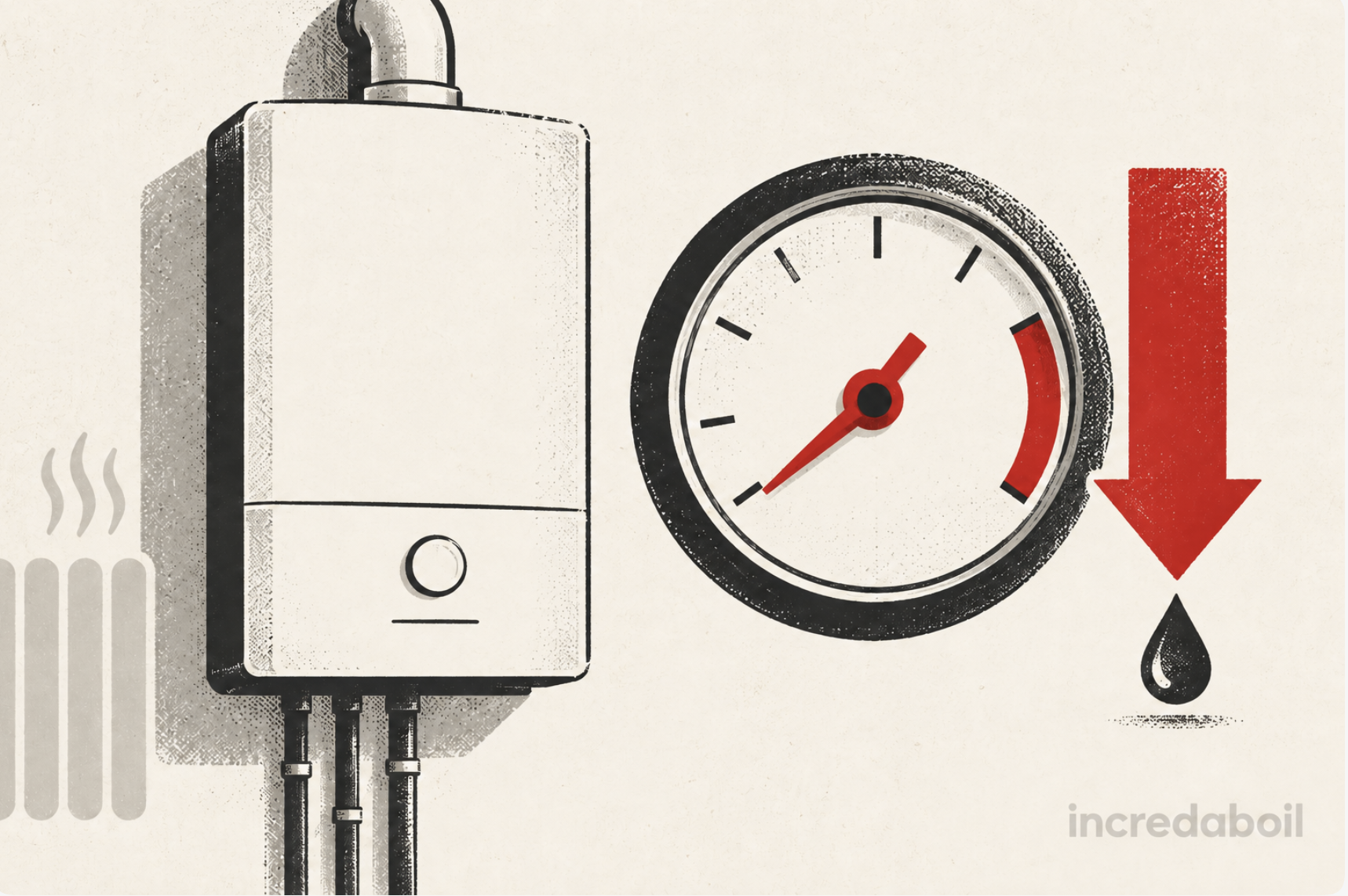
Boiler pressure normally falls a little as the heating switches off and the water cools. That is the reverse of the small rise you see when the system warms. The concern is a reading that keeps falling below the boiler’s normal cold range, reaches the low-pressure warning area, or needs frequent topping up.
If your boiler drops from a normal hot reading to a sensible cold reading and then stays there, it may be behaving normally. If it loses pressure day after day, the system is probably losing water or has a pressure-control fault that needs finding. This guide helps you tell those patterns apart without opening the boiler.
Quick answer: is a pressure drop after heating normal?
A modest drop is normal because heating water expands and cooling water contracts. The useful comparison is not “hot versus cold” on its own. Compare the pressure at the same temperature on different days.
For many domestic sealed systems, manufacturers describe a normal cold reading around 1 to 1.5 bar, although the exact figure depends on the model and installation. Baxi gives a broader normal operating range of 1 to 2 bar. Your boiler’s user manual and the pressure set by the installer take priority.
Worcester Bosch says a heating system will usually need topping up only once or twice a year. Ideal user guides say that pressure continuing to fall below the original 1 to 2 bar installation pressure may indicate a water leak. A repeated loss over days or weeks is therefore different from the ordinary movement of the gauge during one heating cycle.
First, measure it properly
- Turn the heating off and allow the boiler and radiators to cool fully.
- Record the cold pressure shown on the boiler display or gauge.
- If the reading is within the range stated in the exact user manual, note it rather than immediately adding water.
- Run the heating normally and note the highest pressure only if it is safe to do so.
- Check the pressure again after the system has cooled, ideally at roughly the same time and temperature the next day.
A photograph of the gauge can make comparison easier. If the cold reading returns to the same point, the system may simply be showing normal expansion and contraction. If each cold reading is lower than the last, investigate the loss rather than repeatedly topping up.
Why boiler pressure drops when the heating is off
1. Normal cooling
When radiators and heating water cool, the water contracts and the pressure falls. A system that reads around 1.5 to 2 bar while hot may settle closer to its normal cold setting afterwards. The amount varies with system size, temperature and expansion-vessel setup.
The pattern is reassuring when the pressure rises and falls predictably, remains inside the model’s stated range and does not drift lower over successive cold readings.
2. A small leak on the heating system
Sealed-system pressure cannot keep falling without a reason. Baxi and Worcester Bosch both advise checking visible pipe joints, radiators, radiator valves and connections for leakage. Small leaks may evaporate from warm pipework before forming a puddle, leaving only rust, corrosion, staining or a crusty deposit.
Look, but do not dismantle. Check around accessible radiator valves, towel rails, visible pipe joints and beneath the boiler. Also consider recently fitted radiators, valves or other heating work. Pipework hidden under floors or inside walls can leak without an obvious mark, so a clear visual check cannot rule everything out.
3. The pressure-relief valve has discharged
A boiler normally has a safety valve that releases water if system pressure becomes too high. Its discharge pipe often passes through an outside wall and ends as a short copper pipe. Worcester Bosch advises checking this outlet for dripping when a system repeatedly loses pressure.
The sequence can be confusing: pressure rises too high while the heating is on, the valve releases water, and the gauge is low only after everything cools. A problem that appears to be “pressure dropping when off” may therefore have started with excessive hot pressure.
Do not operate the pressure-relief valve as a way to lower pressure and never cap its discharge. Worcester Bosch warns that using the valve to drain a system can introduce debris at the valve seat and leave it dripping.
4. An expansion-vessel problem
The expansion vessel provides space for heating water to expand. If its air charge is low, its diaphragm has failed or the vessel is too small for the system, pressure can climb sharply while hot. The relief valve may then discharge, leaving low pressure after cooling.
A useful clue is a large hot-to-cold swing: perhaps close to the high red area when the heating runs, followed by a low reading once it stops. Worcester Bosch says a rise of more than 1 bar at operating temperature may mean the expansion vessel needs repressurising by a service engineer.
Testing, recharging or replacing an expansion vessel is not a homeowner task. Do not remove the boiler case or try to reach an internal air valve.
5. Air has recently been released
Bleeding radiators releases air and sometimes a little water, so the cold system pressure can be lower afterwards. New or recently worked-on systems can also lose some pressure as dissolved air works its way out through vents. Worcester Bosch installation guidance explains that occasional topping up can be normal after commissioning, but frequent ongoing loss points towards a leak or expansion-vessel fault.
After bleeding, follow the exact boiler manual if the pressure needs restoring. Do not make topping up a routine response without finding out why the pressure continues to fall.
6. A faulty gauge or pressure sensor
If the reading changes suddenly without a temperature change, sticks, jumps or disagrees with another gauge, the pressure sensor or display may be misleading. That needs testing rather than guesswork. A boiler that reports a low-pressure fault despite a normal-looking mechanical gauge should also be checked.
Safe checks you can make
- Check the exact manual. Confirm the stated cold range and the correct filling arrangement for your model.
- Compare cold readings. Use the same conditions rather than comparing a fully hot system with a fully cold one.
- Look for visible water or staining. Check accessible radiator valves, pipe joints and the area below the boiler without removing covers.
- Inspect the outside copper discharge pipe visually. Wetness or staining can indicate that the pressure-relief valve has released water.
- Think about recent work. Radiator bleeding, decorating, a new radiator or system maintenance can explain a one-off change.
- Record any fault message. Use the full code and exact model when speaking to an engineer.
If you smell gas, suspect fumes or a carbon-monoxide alarm sounds, do not continue these checks. Leave the property and follow the National Gas Emergency Service instructions. A pressure problem and a gas emergency are separate issues.
Should you top the pressure up?
If the cold pressure is below the range in the user manual and the filling controls are intended for homeowner use, one careful top-up may restore operation. Identify the filling device from the exact instructions, keep the gauge in view, add water slowly and close every filling control fully at the stated pressure.
Do not copy a valve sequence from a different boiler. Baxi, Worcester Bosch and Ideal models can use different external hoses, keys, levers or built-in arrangements. Stop if you cannot identify the controls with certainty, a valve is seized, or water leaks from a connection.
Topping up replaces lost water; it does not repair the cause. Arrange an inspection if the pressure falls again soon, if you need to refill repeatedly, or if the hot pressure rises unusually high first.
When to switch the boiler off and call an engineer
Arrange professional help when:
- the pressure reaches the low-warning area or the boiler locks out repeatedly;
- the cold reading keeps falling over several days;
- water is visible beneath the boiler or around its casing;
- the outside relief pipe is dripping;
- pressure climbs towards 3 bar while heating and then drops very low when cold;
- the filling loop will not close or the pressure rises while the boiler is cold;
- hidden pipework may be leaking; or
- you cannot safely identify the filling arrangement.
Worcester Bosch advises turning off a leaking boiler and contacting a Gas Safe registered engineer. Gas Safe Register also warns against DIY repair work on gas appliances. A functional boiler case that forms part of the combustion circuit must not be removed by a consumer.
Baxi, Worcester Bosch and Ideal guidance
Baxi boilers
Baxi identifies several common reasons for low pressure: air released from the system, visible or very small heating leaks, an expansion vessel that needs professional attention, and a pressure-relief valve that is not sealing. Its homeowner guidance suggests checking for rust, corrosion and staining around accessible pipes, radiators and valves.
Worcester Bosch boilers
Worcester Bosch describes approximately 1 to 1.5 bar when the system is cool and says frequent repressurising should be referred to the installer. Its fault-finding information separates a straightforward leak from a pressure-relief or expansion-vessel pattern by considering whether pressure rises substantially while the heating runs.
Ideal boilers
Current Ideal Logic Combi2 instructions state that a continuing fall below the original 1 to 2 bar installation pressure may indicate a water leak. The guide tells users to contact a Gas Safe registered engineer if they cannot restore the pressure or if it keeps dropping. The cited model’s filling target is 1 to 1.5 bar, but owners should check the manual for their exact Ideal boiler.
What an engineer may investigate
The engineer will use the pressure pattern and inspection results to decide whether the loss is from accessible heating pipework, concealed pipework, the boiler, a relief discharge or an expansion-control problem. They may test the expansion vessel, relief valve and pressure sensor, but those procedures are deliberately not reproduced here because they involve professional appliance work.
Tell the engineer the cold and hot readings, how quickly pressure falls, whether topping up changes the pattern, and whether any recent radiator or boiler work has taken place. Photographs of the gauge and any staining can help.
Frequently asked questions
Why does pressure drop overnight?
The gauge will normally be lower after the system cools overnight. If each morning’s fully cold reading is lower than the previous one, water may be escaping through a leak or relief discharge, or an expansion-vessel fault may be causing water loss during hot operation.
Can a boiler lose pressure without a visible leak?
Yes. A micro-leak can evaporate on warm pipework, pipework may be hidden, or water may be leaving through the outside pressure-relief pipe. An expansion problem can also cause discharge only while the system is hot.
Is it normal to top up once a year?
Worcester Bosch says topping up once or twice a year can be normal. The exact pattern matters: a new system settling is different from a boiler that loses pressure every few days. If the frequency increases, arrange a check.
Why is pressure low only when the boiler is cold?
Some difference between hot and cold is expected. If the cold reading remains within the manual’s range and is stable from day to day, it may be normal. A very large swing or a cold reading that keeps declining suggests a fault.
Can I use leak sealer?
Do not add a chemical product simply because the gauge falls. The cause and the product’s compatibility with the boiler and system need to be established first. Ask a competent heating professional.
Will resetting the boiler restore pressure?
No. A reset may clear a lockout only after the underlying pressure is correct; it cannot replace lost water or repair a leak. Do not repeatedly reset a boiler that returns to the same fault.
Related boiler-help guides
- Why does my boiler keep losing pressure?
- Why does boiler pressure rise to 3 bar?
- How to top up your boiler pressure
- How to bleed a radiator safely
Pressure falling every time the heating cools?
Book a fixed-price Incredaboil repair visit for an eligible Baxi, Worcester Bosch or Ideal boiler and get the cause properly checked.