
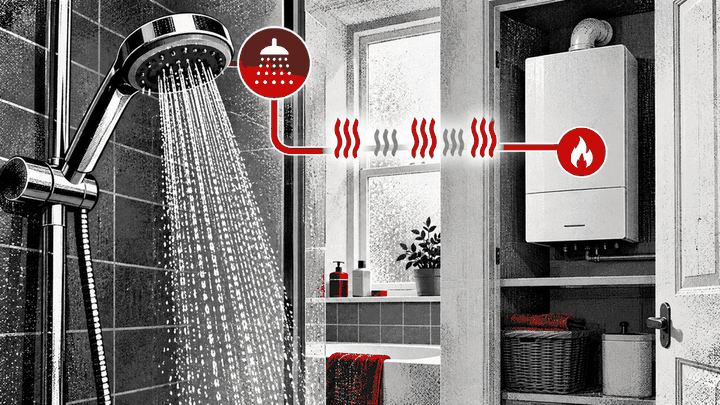
Can a water-saving shower head make a combi boiler cycle?
Yes, it can in some installations—but a water-saving head is not automatically faulty or unsuitable. A combi must detect enough hot-water flow to start and keep running. If the shower head, hose and mixer reduce the hot side close to the exact boiler’s operating threshold, demand can start and stop repeatedly. The result may feel like alternating hot and cold water. The pattern still needs checking because a scaled head, damaged hose, shower-valve fault, weak mains supply or boiler fault can look similar.
First confirm that the shower is a mixer supplied by the combi. An electric shower heats its own cold-water supply and needs different guidance. With every other outlet off, compare the shower with one ordinary hot tap and watch the closed boiler’s display. If the tap stays steady but the shower makes the hot-water symbol appear and disappear, low or unstable shower flow is a useful clue. Do not remove a flow regulator permanently, fit an unapproved head, dismantle the mixer or open the boiler.
Why a combi needs a minimum hot-water flow
A combination boiler heats mains water when an outlet creates demand. Inside the appliance, controls detect the draw and operate the burner and heat-transfer system. Those controls cannot respond reliably to an indefinitely tiny trickle; manufacturers publish model-specific operating flow rates or start and stop thresholds.
Baxi’s current Main Eco Compact Combi data, for example, lists a minimum domestic-hot-water operating flow of 2 litres a minute. An Intergas product brochure gives 1.5 litres a minute for several HRE combi models. These figures are examples, not universal settings. The threshold for your boiler must come from its own current manual and model data.
When the hot side of a mixer shower hovers around that threshold, small changes at the shower valve, mains supply or boiler can move it above and below the point at which demand is recognised. The boiler may light, heat the water, lose the demand, stop, then receive another demand. At the shower, that sequence can arrive later as hot-cold-hot-cold water because the pipe contains water heated at different moments.
What the water-saving head changes
A water-saving shower head limits the litres delivered each minute, changes the spray pattern, mixes air into the spray, or combines these methods. Reducing total shower flow can save water and reduce the energy needed to heat it. The effect on the combi depends on how the mixer divides that smaller total between hot and cold.
If the shower is set warm, the hot portion may be only part of the total flow. A head advertised at a modest overall flow could therefore leave the boiler seeing less hot flow than the headline figure. Thermostatic mixers also adjust their blend as inlet temperatures and pressures change.
A suitable head on a compatible system can work perfectly. Problems are more likely when the original arrangement was already marginal, the new head is substantially more restrictive, its nozzles have scaled up, the hose is kinked or internally damaged, or another outlet reduces the available mains flow.
Make sure the shower actually uses the combi
A mixer shower takes hot water from the household hot-water system and blends it with cold. That is the arrangement in which a restrictive outlet can affect the hot-water demand seen by a combi.
An electric shower normally takes cold mains water and heats it inside the shower unit. A power shower usually pumps stored hot and cold water. A digital shower can be arranged in several ways. If the boiler does not show a hot-water demand when the shower runs, identify the shower before assuming a boiler interaction.
Do not put a generic water-saving head on an electric shower. Mira’s current electric-shower instructions warn that only specified shower heads should be fitted and that no additional device should restrict outlet flow. A blocked head or hose can raise the delivered temperature and create a scalding risk. Use only accessories approved for the exact shower.
Why a new head may reveal an existing weakness
The timing matters. If the cycling began immediately after the head was changed and stops when the correct original head is refitted, compatibility becomes a strong clue. It does not prove the boiler is healthy: the old head may simply have kept the flow comfortably above a marginal threshold.
If the same head worked for months and the problem developed gradually, limescale, debris, a collapsing hose, a changing mixer cartridge or a supply issue becomes more plausible. Mira advises keeping shower heads free of limescale and checking hoses for kinks, blockage or internal collapse because each can reduce flow.
If every hot tap now cycles, the problem is no longer confined to the shower head. Read why hot water can run hot, cold, hot and cold and arrange a boiler check where appropriate.
A safe comparison that gives useful evidence
- Keep children and anyone vulnerable to scalding away from the test.
- Make sure washing machines, toilets, taps and other showers are not drawing water.
- Let one ordinary hot tap run at a normal useful flow and note whether its temperature and stream settle.
- Close the tap, allow the boiler to return to standby, then run the mixer shower at its normal setting.
- Watch the boiler display from outside the casing. Note whether the hot-water symbol stays on or repeatedly disappears.
- Record the approximate length of each warm and cool phase, the shower setting and any change in spray strength.
Do not put your hand directly into a shower that may become suddenly hot. Stand clear until the temperature has stabilised. HSE warns that changing flow and pressure can create unsafe shower temperatures, particularly for people at higher risk of scalding.
Can I try the shower without its head?
Only follow a head-off comparison when the exact shower manufacturer’s user instructions permit it and the water can discharge safely into the tray or bath. Some manufacturer troubleshooting uses this comparison to distinguish a blocked head from a hose or valve problem. It is not suitable for every electric, digital, pumped or specialised shower.
If permitted, keep clear of the water, use the ordinary temperature position and stop immediately if flow, temperature or the shower’s behaviour is abnormal. Never use the shower like this for bathing. Refit the correct head exactly as the user guide describes.
Do not remove the flow regulator as a permanent fix
A regulator may be part of the head’s designed performance, water-efficiency rating, spray quality or safe operating arrangement. Removing it can increase water and energy use, upset a thermostatic mix, damage the product or make it incompatible with the shower.
If the water-saving head is unsuitable for the available supply or boiler, replace it with a head approved for the shower and matched to the plumbing system. Do not drill nozzles, enlarge internal openings, remove check valves or fit an improvised restrictor.
The head may be restricted rather than deliberately low-flow
Water-saving design and accidental blockage are different. Limescale can close individual spray holes, while debris can collect at an inlet screen. A hose can look normal outside while its liner has collapsed.
Use only the cleaning method in the exact head’s instructions. Many manufacturers allow wiping flexible nozzles and descaling a removable head, but finishes and internal parts vary. Do not use harsh chemicals, push objects into jets or dismantle a thermostatic shower valve.
Mira’s current support guidance says that if a shower runs correctly without the head, a blocked head is indicated; if performance improves only after the hose is removed, the hose may be kinked, blocked or internally collapsed. It reserves internal filter and valve checks for a qualified tradesperson.
Other causes that can mimic a restrictive head
- A thermostatic mixer cartridge that is sticking or reacting poorly.
- Blocked shower filters that require professional attention.
- A kinked or collapsed flexible hose.
- Partly closed isolation valves after plumbing work.
- Low dynamic mains flow when another outlet operates.
- A boiler hot-water flow sensor, plate heat exchanger or control fault.
- A boiler set too hot for the small useful shower flow, depending on the model.
- Seasonally colder incoming water exposing a marginal flow-and-output combination.
These are possibilities, not diagnoses. The distinction between one affected shower and every hot outlet is often more useful than guessing a component.
When to stop using the shower
Stop and arrange competent help if the water becomes unpredictably very hot, the thermostatic safety control does not limit temperature, flow becomes very weak, the shower or boiler shows a fault, water leaks from the unit, or a vulnerable person cannot use it safely.
If someone is scalded, NHS guidance says to cool the affected area under cool running water for 20 minutes and seek the appropriate medical help. Do not use ice, creams or greasy substances.
Who should investigate?
A competent plumber or the shower manufacturer’s service engineer can assess the head, hose, mixer, filters, check valves, supply balance and product compatibility. Work that involves the gas boiler or its integral controls belongs with an appropriately qualified Gas Safe registered engineer. Gas Safe Register states that an integral appliance casing should not be removed by a consumer.
Give the engineer the boiler and shower make and model, when the head changed, whether the tap remains stable, what the boiler display does, and whether other water use changes the pattern. That evidence narrows the job without an unsafe trial.
Related questions
Why does turning the shower up sometimes stop the cycling?
On some mixers, a different setting changes the hot-water share or total flow enough to keep the boiler above its threshold. It is a clue, not a repair, and the hotter position may increase scalding risk.
Will a higher-flow head waste water?
It can use more litres per minute. The appropriate choice balances water efficiency, the shower’s approved accessories, the available supply and stable hot-water operation.
Why does the shower work when a hot tap is also open?
The extra tap may raise total hot-water flow through the boiler and keep demand active. Do not use two outlets as a permanent workaround; it wastes water and indicates the system needs assessment.
Could the boiler be oversized?
Minimum controllable hot-water output and minimum detection flow are model-specific. An engineer must measure the actual flow and temperature pattern before drawing that conclusion.
The practical conclusion
A water-saving shower head can make a combi cycle when the hot side of the shower falls close to the boiler’s minimum operating flow. But the head is only one part of a path that includes the mixer, hose, filters, pipework, mains supply and boiler controls.
Confirm the shower type, compare it with one steady hot tap and record the closed boiler’s display. Clean only what the shower’s user guide identifies as homeowner maintenance, keep safety devices intact, and use an approved head. For the paired diagnosis, read why a combi can stay steady at a tap but cycle at the shower.
Shower making the boiler cycle?
Have the shower flow, mixer and combi hot-water response checked together.