
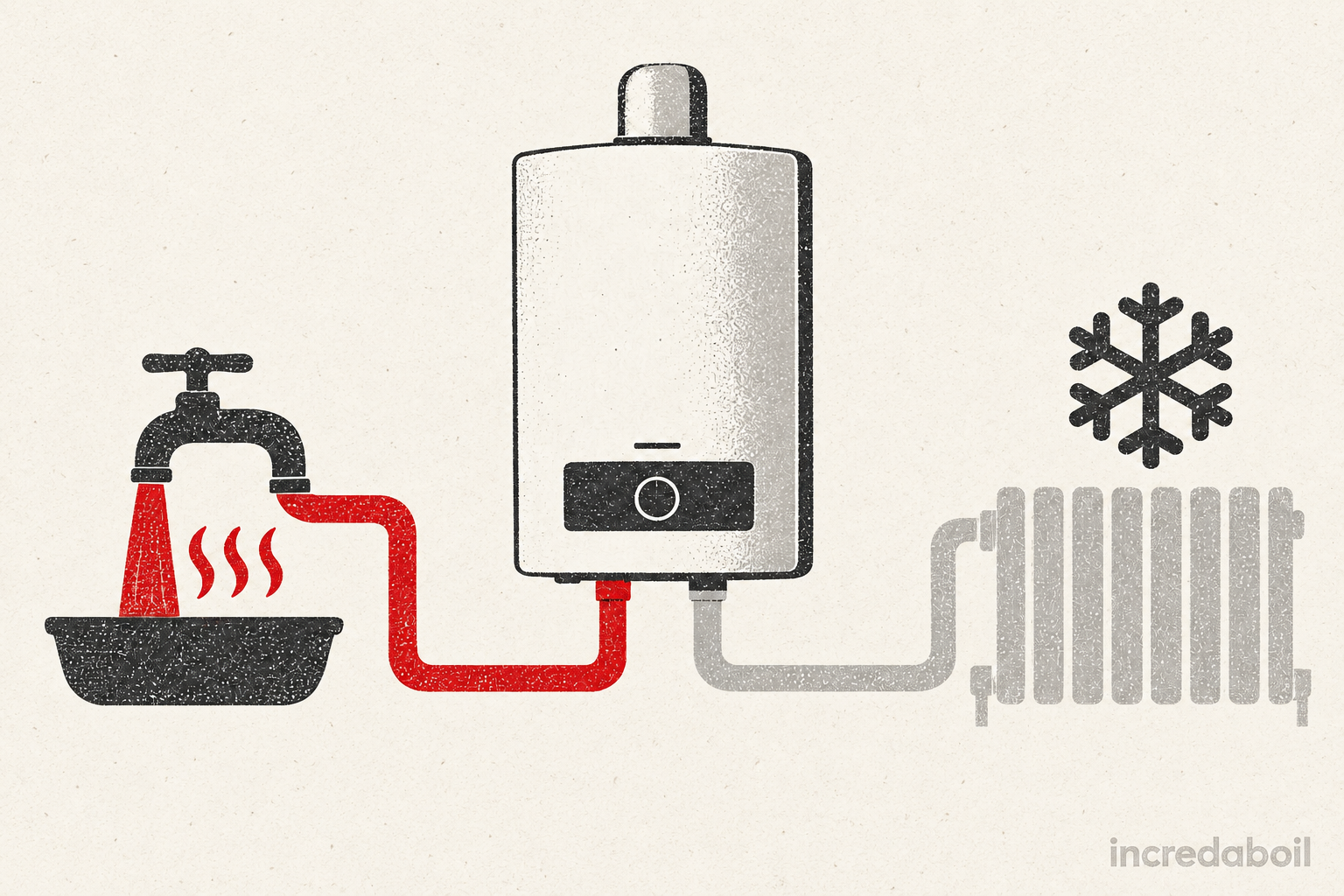
If a Vaillant combi boiler provides hot water but no central heating, the boiler can respond to tap demand but is not producing useful heat for the radiators. Start with heating mode, programme, room thermostat, system pressure and radiator valves. Vaillant’s own homeowner guidance says a combi may simply be set to heat water only, particularly after summer.
If the controls are definitely calling for heat and all radiators remain cold, the fault may be in the thermostat or receiver, a heating zone, circulation, a valve or the boiler. Do not remove the case or attempt internal repairs. This guide helps you collect the right evidence for a qualified engineer.
Why hot water can work while heating does not
A combi boiler serves two demands. Opening a hot tap asks it to heat domestic water immediately. Central heating starts only when the heating controls request it. Working hot water therefore confirms that the appliance has power and can operate for one demand, but it does not prove that the room controls, heating circuit or every internal component is healthy.
Vaillant explains that its controls can manage heating and hot water separately. Older Vaillant operating instructions for combi models specifically tell users with hot water but no heating to check that heating and all external heating controls are switched on.
Safe checks in the right order
1. Check that central heating is enabled
Look at the boiler and controller’s normal user displays. Make sure the heating circuit has not been set to Off, Summer, hot-water-only, Holiday or frost-protection mode. Vaillant notes that a combi can be left in a setting that heats water but not radiators after summer.
Use the exact manual for your boiler and controller because the symbols vary. Do not enter installer menus or change commissioning settings. If an app controls the heating, check whether it reports the system offline or disconnected.
2. Create a clear thermostat demand
Set the room thermostat a few degrees above the temperature it currently reads. Energy Saving Trust explains that a room thermostat turns the heating on until the chosen temperature is reached, while a programmer determines when operation is allowed.
Check the day, clock and active time period, especially after a power cut, battery change or seasonal clock change. A flame or radiator symbol on the thermostat often means it is requesting heat; it is not independent confirmation that the burner has lit.
3. Check thermostat batteries and receiver status
For a wireless Vaillant or third-party thermostat, look for low-battery, signal or connection warnings. Replace batteries only as the controller manual directs. Watch whether any accessible receiver demand light changes when the target temperature is raised.
If the thermostat shows demand but the receiver does not, communication or control setup may be involved. Do not press random pairing buttons, bridge wires or open a receiver mounted inside the boiler casing.
4. Read the boiler display and pressure
Record any message, status symbol or fault code exactly. Check the sealed-system pressure against the user guide for the precise Vaillant model. Vaillant’s general advice says an ideal pressure is often around 1.5 bar, but it can vary; older model instructions may describe a green band or a different limit.
If pressure is below the manual’s permitted range and the guide provides a homeowner filling procedure, follow it only if you can identify every control with confidence. If pressure falls again, a leak or pressure-control problem needs investigation rather than repeated filling.
5. Check whether every radiator is cold
If only one radiator is cold, first check its normal thermostatic and lockshield-side user setting without dismantling the valve. Air, a stuck valve or balancing may affect one radiator while the boiler and the rest of the system operate.
If every radiator is cold, the cause is more likely to affect the heating demand or circulation as a whole. Check whether one heating zone works while another does not. Underfloor heating and multi-zone homes can have separate thermostats and valves.
6. Observe what the boiler does when heating is requested
From outside the appliance, note whether a heating or radiator symbol appears, whether a flame indication follows, whether the displayed flow temperature rises and whether any pipes or radiators begin warming. Wait several minutes because some boilers use short anti-cycle delays.
A boiler that never shows a heating request points back toward the external controls. A heating request with no ignition, a returned fault code or a boiler that fires but sends no heat to radiators requires professional diagnosis.
7. Try only a model-directed reset
If the display shows a lockout and the exact Vaillant user guide instructs you to reset it, use the normal user control once. A reset cannot repair a thermostat link, failed valve, circulation fault or recurring ignition problem.
If the same fault returns, stop resetting and arrange a repair. Do not repeatedly interrupt the electrical supply in an attempt to force the boiler to run.
What the different patterns suggest
No heating symbol appears at the boiler
The schedule, operating mode, thermostat target, batteries, wireless link or control wiring may be preventing a valid demand. Check user settings first. Testing wiring and boiler inputs is professional work.
Heating symbol appears but there is no flame
The boiler may be in a normal waiting period or prevented from firing by a fault or safety condition. Record any status code and the pressure. If it does not start after a reasonable wait, arrange diagnosis.
The boiler fires but all radiators stay cold
Circulation, a pump, zone valve, airlock, closed service valve or system blockage may be involved. Do not remove the casing, run internal tests or force valves. Tell the engineer whether boiler temperature rises rapidly or whether any section of pipework warms.
Hot water is normal and radiators are completely cold
Vaillant’s homeowner guidance lists hot water with no heating as a possible diverter-valve symptom on combi boilers. It is not the only cause. The diverter valve routes heated water between taps and radiators, but confirming or repairing it requires a qualified engineer.
Some radiators heat and others do not
This is less likely to be a total boiler failure. Check normal radiator valve settings and note whether the affected radiators are upstairs, downstairs or in one zone. Air, balancing, a zone valve or system contamination may be relevant.
Could it be a diverter valve?
On a Vaillant combi, the diverter valve directs heat toward domestic hot water or central heating. Vaillant says hot taps working while radiators remain cold can be a symptom of a diverter-valve fault. Other symptoms can include lukewarm tap water or hot water behaving differently when heating is selected.
Do not treat that pattern as a confirmed diagnosis. Control problems can produce the same complaint, and system or regular boilers use different arrangements. A diverter valve is inside the appliance and must not be freed, cleaned or replaced by a homeowner.
Could trapped air be the cause?
Vaillant suggests trapped air as one possible reason radiators do not heat. Air usually produces cold areas, gurgling or uneven performance rather than every radiator staying completely cold. If you know how to bleed a radiator safely and the system manual permits it, switch the heating off, let radiators cool and use the correct key.
Bleeding releases air and can lower system pressure. Check the gauge afterwards and follow the exact model instructions if pressure needs restoring. Stop if water is very hot, the bleed screw is damaged or pressure repeatedly falls.
When lack of heating is urgent
NHS advice says a comfortable home should, if possible, be at least 18°C in regularly used rooms, particularly for people with health conditions. Older people, babies, young children, pregnant people and those with long-term illness or disability can be more vulnerable to cold.
Prioritise a prompt repair when vulnerable occupants are present or severe weather is expected. Use safe temporary electric heating according to the manufacturer’s instructions, keep heaters clear of fabrics and never use a gas oven, cooker or barbecue to heat the home.
Do not attempt these repairs
- Do not remove the boiler or combustion casing.
- Do not bridge thermostat or control terminals.
- Do not force or dismantle a diverter or zone valve.
- Do not test internal pumps, gas valves or ignition parts.
- Do not bypass pressure or temperature safety controls.
Gas Safe Register advises against DIY gas-appliance work. If you smell gas, leave the affected area and call the National Gas Emergency Service on 0800 111 999 from outside or another safe place.
What to tell the engineer
- the full Vaillant model and controller names;
- whether hot water is fully hot or only lukewarm;
- whether every radiator or only one zone is cold;
- the cold system pressure;
- what the thermostat, receiver and boiler display show;
- whether the boiler fires for heating demand; and
- anything that changed recently, including batteries, a power cut or system work.
This information helps distinguish an external-control problem from circulation, zoning or appliance faults without guessing at parts.
Frequently asked questions
Why does my Vaillant heat tap water but not radiators?
The boiler responds to a separate hot-water demand. Heating may be disabled at the controls, the thermostat request may not reach the boiler, or the heating circuit or appliance may have a fault.
Should I reset the boiler?
Only when a lockout and the exact Vaillant user guide call for it. One reset may clear a temporary condition; repeated resets are not a repair.
Could low pressure cause no heating?
Yes. Check the model’s displayed pressure against its manual. If pressure falls again after filling, arrange an investigation rather than repeatedly adding water.
Does working hot water rule out the boiler?
No. It proves the boiler can respond to hot-water demand, but heating uses additional controls and may use components differently.
Can I repair a diverter valve myself?
No. It is an internal appliance component. A qualified engineer should confirm the diagnosis and carry out the work.
Related boiler-help guides
- Thermostat says heating is on but the boiler is not firing
- Hot water but no central heating
- Why is one radiator not heating up?
- Why does boiler pressure keep dropping?