
The best smart thermostat is not automatically the one with the longest feature list. It is the control that matches your heating system, gives your household a comfortable way to make changes and avoids paying for functions you will never use.
Start with the plumbing and wiring, then consider the app. A one-channel combi-boiler kit, a two-channel system for heating and a hot-water cylinder, and a multi-zone home can all need different hardware. Buying the wrong version of the right brand still produces the wrong result.
This guide compares mainstream UK choices and includes example hardware prices checked in September 2026. Prices change, sales come and go, and professional installation is normally additional unless a seller explicitly includes it.
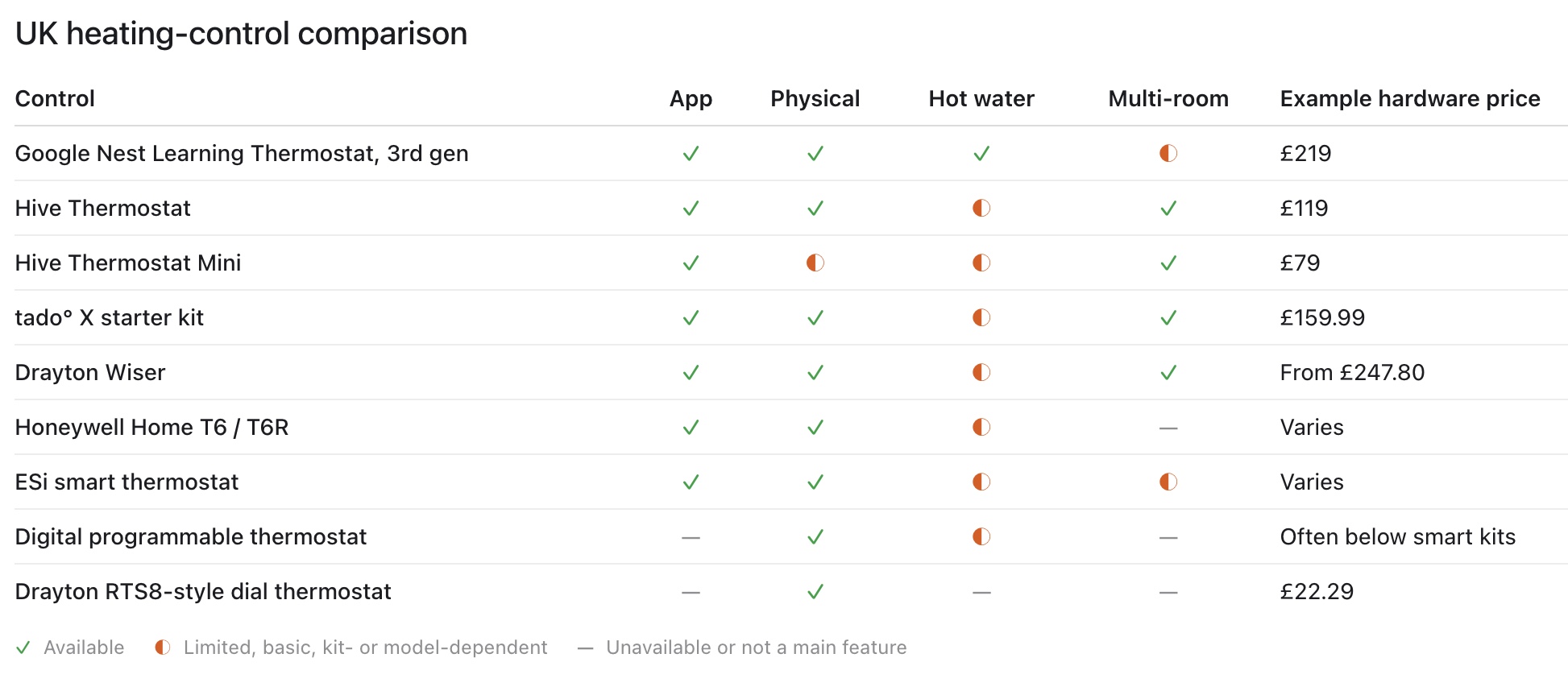
Quick tick-box comparison
First question: what heating system do you have?
Combi boiler
A typical single-zone combi boiler provides hot water on demand, so the control usually needs one heating channel. That makes products labelled “one channel” or “combi kit” the usual starting point. A combi can still have multiple heating zones, so do not assume one channel without checking.
System or regular boiler with a cylinder
If a programmer currently controls both central heating and stored hot water, choose a kit designed for both. Some smart thermostats can schedule cylinder hot water, but the receiver and channel arrangement matter. A heating-only kit may leave you without the control you expected.
More than one heating zone
Newer or larger homes may have separate upstairs and downstairs circuits. That is different from fitting smart heads to individual radiators. Count the wired zones and identify the valves before choosing a kit.
Is Nest still available, or is it defunct?
Nest is not defunct in the UK. Google’s UK Store still listed the third-generation Nest Learning Thermostat for £219 when this guide was checked. It remains a recognisable choice for homeowners who like its circular display, automatic learning and ability to control stored hot water on suitable installations.
The confusion is understandable. Google has changed parts of the Nest product range over time, and the UK store showed the Nest Thermostat E as out of stock when checked. The sensible buying approach is to confirm the exact current product, app support and compatibility on Google’s UK pages rather than assuming that every Nest model mentioned in an older article is still equally available. Accurate at time of publication
Which thermostat suits which priority?
Choose Nest if learning and design matter most
The Nest Learning Thermostat suits households that want a polished physical control and automatic schedule learning. It can connect through Heat Link and supports OpenTherm with compatible boilers. It is not the cheapest choice, and homeowners focused on room-by-room radiator control may prefer a system built around smart radiator thermostats.
Choose Hive for a familiar mainstream ecosystem
Hive is easy to shortlist because there are two thermostat price points and a wider range of compatible devices. The main thermostat was £119 and the Mini £79 on Hive’s own shop when checked. Standard schedules and boosts are available, while some advanced insights and automation sit within the optional Hive+ service. Check whether the features you value require that ongoing payment.
Choose tado° or Wiser for an expandable room-by-room system
Both ranges make sense if individual room schedules are part of the plan. tado° X starter kits were listed at £159.99, with add-on radiator thermostats sold separately. Drayton Wiser offers one-, two- and three-channel kits and an extensive set of room and radiator additions. Current second-generation kits started from £247.80 on the direct Wiser shop when checked.
Calculate the whole-home cost, not merely the starter kit. Eight smart radiator thermostats can cost much more than the central thermostat, and they may require a bridge or hub. Decide which rooms genuinely need independent schedules before filling every radiator.
Choose Honeywell Home for a thermostat-first approach
Honeywell Home T6 and T6R controls suit people who want modern scheduling and app control without necessarily building a room-by-room system. Wired and wireless versions serve different installations. Check the exact suffix and included receiver rather than buying by the T6 name alone.
Choose ESi for familiar controls with smart options
ESi covers everything from simple dial thermostats to Wi-Fi and OpenTherm-capable controls. Current ranges include Stratus and Mistral, while many homes already contain Series 5 or Series 6 units. Some ESi products keep conventional local or RF operation when Wi-Fi is unavailable, which can be attractive where basic operation must remain obvious.
When a non-smart thermostat is the better buy
A smart product is unnecessary if you have a predictable routine, rarely alter the schedule remotely and prefer not to manage another account. A programmable room thermostat can set several temperatures across the day and continue working without broadband. For many households, that is the useful core of smart heating without the cloud connection.
A basic dial thermostat remains the simplest option. The Drayton RTS8 was £22.29 at Toolstation when checked, although a separate timer or programmer is still needed to control operating periods. The comparison is not £22 versus £219 for the same job: the smart product combines or adds scheduling, remote control and automation that the dial alone does not provide.
Features worth paying for
- Clear scheduling: the most valuable feature is one your household will actually use.
- Local controls: heating should remain understandable to guests and people without the app.
- Correct hot-water control: essential where a cylinder is part of the system.
- Modulation: useful only when the thermostat and boiler genuinely support the same communication method.
- Multi-room expansion: valuable when rooms are occupied at different times, but budget for every required valve, sensor and hub.
- Offline behaviour: check what happens when Wi-Fi, broadband or the provider’s service is unavailable.
- Household access: make sure more than one person can control the heating without sharing an unsuitable personal login.
Features to treat carefully
Geofencing can be useful, but it needs correct phone permissions and sensible handling of several occupants. Learning can reduce repeated programming, but it may also reproduce unusual temporary behaviour until corrected. Energy reports show patterns; they do not necessarily measure gas consumption unless the system has suitable data. Voice control is convenient, but it should not be the only easy way to change the temperature.
Will a smart thermostat save money?
It can, particularly when it replaces poor scheduling or frequent heating of an empty home. Energy Saving Trust says results depend on the controls and behaviour you start with. If a conventional programmable thermostat is already set carefully, the extra saving from changing hardware may be modest. If nobody understands the old programmer and the heating runs far longer than needed, an easier interface can make a meaningful difference.
Do not accept a universal percentage as a prediction for your home. Insulation, weather, occupancy, boiler setup and chosen temperatures all affect use. The simplest sound principle is to heat occupied spaces at the lowest comfortable temperature for the periods they are needed.
Compatibility questions for the installer
- Which exact kit matches my boiler type and number of zones?
- Will it control my hot-water cylinder?
- Will the connection be on/off, OpenTherm or manufacturer-specific modulation?
- Where will the thermostat measure temperature accurately?
- What works if the internet is unavailable?
- Can I add radiator controls later without replacing the starter kit?
- Does any feature I want require a paid service?
Do not remove the boiler case or connect mains control wiring yourself unless you are competent and authorised to carry out that work. A heating engineer can identify the system, check terminal compatibility and position the sensor away from draughts, direct sunlight and heat sources.
Our practical shortlist
For a simple app-controlled upgrade, compare Hive, Honeywell Home T6 and the appropriate ESi smart kit. For learning and a premium wall control, consider Nest. For planned room-by-room expansion, compare tado° X and Wiser by pricing the complete system you would eventually own. If remote control will rarely be used, choose a good programmable thermostat and spend the difference elsewhere.
Related boiler-help guides
- What is a smart thermostat?
- Do smart thermostats work with older boilers?
- How do I programme my Hive thermostat?
- How do I program my Honeywell thermostat?
- How do I program my ESi thermostat?
Does your boiler ignore the thermostat?
If an eligible natural-gas boiler is not responding to its controls, book a fixed-price diagnosis and repair in Leeds.