
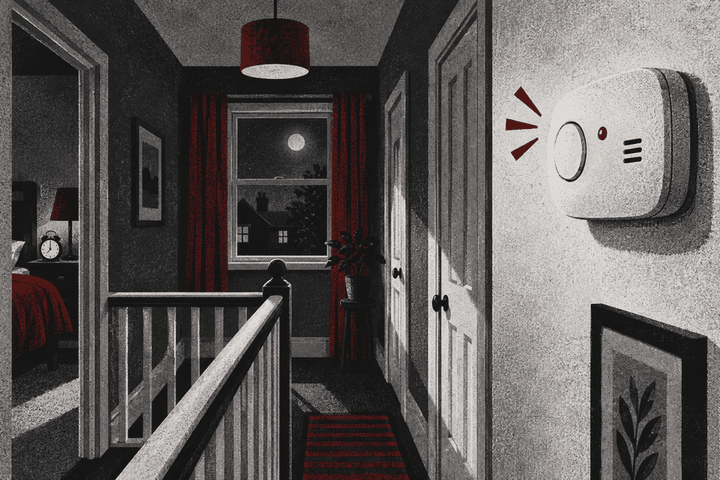
Why does a carbon-monoxide alarm chirp only at night?
A carbon-monoxide alarm that seems to chirp only at night may be giving a low-battery, fault, extreme-temperature or end-of-life warning, or it may simply be easier to hear when the house is quiet. Some models also change their indicators or silence behaviour during recognised night hours. The meaning depends on the exact make and model, so the sound pattern, lights, display and replace-by date matter more than the time on the clock.
First distinguish a single maintenance chirp from the alarm’s full carbon-monoxide warning. If it is a full alarm, a CO reading is shown or anyone has possible symptoms, go outside into fresh air and follow the alarm, NHS and gas-emergency guidance. If it is one brief recurring chirp, note the exact pattern without covering or disabling the device, identify the model and follow only its current manual. A sealed-battery alarm, a faulty unit or an alarm at end of life normally needs replacing rather than opening.
A chirp is not the same as a carbon-monoxide alarm
People understandably describe every noise as “the alarm beeping”, but manufacturers use different sounds for different conditions. A maintenance warning is often one or several short chirps repeated at an interval, accompanied by an amber light or a message. The emergency carbon-monoxide pattern is usually louder and deliberately urgent, often with a red light, voice message or displayed reading.
There is no safe universal translation such as “one beep means battery” for every alarm. Kidde and FireAngel guides show different combinations for low battery, fault and end of life, and even models from one manufacturer can differ. Read the label and the exact model manual before interpreting it.
Do not stay beside the alarm to count sounds during a full warning. Carbon monoxide has no colour, smell or taste. If the warning could be a CO alarm, leave first and resolve the pattern from a safe place.
Why it may become noticeable at night
The simplest explanation is often the soundscape. Daytime conversation, traffic, television, appliances and movement can mask a short chirp. At night the same warning can wake someone even though it has been occurring all day. Check whether another household member has heard it earlier and whether the alarm’s indicator history records a condition.
Room conditions can also change overnight. Heating schedules may allow a landing, spare room or utility area to cool. Batteries can behave differently at low temperature, and alarms have stated operating ranges. A room that falls outside the product’s permitted range can produce a model-specific warning or affect performance. Do not assume that cold proves a flat battery, and do not warm the alarm with a hairdryer, radiator or other heat source.
Some alarms deliberately recognise night conditions. FireAngel documents night sensing and a Sleep Easy function on certain models: low-battery chirps may be silenced for a defined period while protection continues, and indicator brightness or an extreme-temperature warning may change at night. That is an example of model-specific behaviour, not a rule for every alarm.
Common possibilities to check against the correct manual
Low battery
A replaceable-battery alarm may chirp when its battery becomes low, loose or unsuitable. A sealed-battery model can also report low power, but the battery is not designed for household replacement; the manual may tell you to replace the entire alarm. Use only the approved battery type where replacement is allowed.
End of alarm life
Carbon-monoxide sensors and alarms have a finite service life. A replace-by date or end-of-life indication means the unit itself needs replacement. Fitting a fresh battery to a replaceable-battery model will not restore an expired sensor. Kidde describes end-of-unit-life mode on its ten-year sealed alarm, while its product guidance warns that an alarm in this mode must be replaced.
Fault or environmental warning
Self-monitoring alarms can chirp for a sensor, circuitry or button fault. Some models also warn about extreme temperature. Dust, paint, sprays, condensation, a water leak or unsuitable placement may be relevant, but never diagnose the cause without the manual. A fault indication matters because the alarm may no longer detect CO reliably.
Another device
A short night chirp can travel along a hallway and seem to come from the wrong device. Smoke alarms, CO alarms, security sensors, wireless doorbells, chargers and other equipment can all make brief warnings. Identify the device from its synchronized light or display without removing protective equipment.
Record the pattern without weakening protection
Once there is clearly no emergency alarm or illness, write down the time of each chirp for several cycles. Note whether it is one chirp or a group, the interval, the colour and number of flashes, any displayed letters or numbers, and whether other linked alarms respond. A short recording can help the manufacturer or landlord, but do not delay emergency action to make one.
Photograph the front, make, exact model and replace-by date. If the rear label is visible through a normal user step described in the manual, photograph it; do not detach a mains-wired unit or open a sealed case. Note the room temperature from an ordinary room thermometer if one is available, not by placing anything on the alarm.
Also record when heating turns off, whether a window is open, and whether the chirp stops after the room warms normally the next day. These observations can reveal a pattern without claiming a diagnosis.
What you can safely do
- Use the exact manufacturer guide for the model printed on the alarm.
- Use the test, reset or silence control only as that guide describes.
- Replace a user-replaceable battery only with the specified type and polarity.
- Replace the whole alarm when a sealed battery, fault or end-of-life instruction requires it.
- Keep the alarm in its specified location and operating conditions.
- Report a questionable rented-home alarm promptly in writing.
A temporary silence function is not a repair. FireAngel’s Sleep Easy description says it provides a limited quiet period so the battery or sealed alarm can be dealt with; it does not remove the need for action. Never infer that another brand has the same feature.
What not to do during the night
- Do not remove the battery, detach the alarm, cover the sounder or put it in a cupboard.
- Do not open a sealed case or try to replace a sealed cell.
- Do not spray cleaner, compressed air or insecticide into the alarm unless its manual expressly permits a cleaning method.
- Do not move it closer to a heater simply to stop a warning.
- Do not test it with vehicle exhaust, a flame or combustion fumes.
- Do not repeatedly silence a fault instead of arranging replacement.
- Do not reset or clear a peak reading before it has been recorded.
If a replacement cannot be obtained immediately, follow the manufacturer’s support advice and arrange prompt cover. Do not continue using a suspected combustion appliance on the assumption that a second alarm will compensate for a defective one.
For tenants and landlords
In England, current government guidance says relevant landlords must repair or replace a prescribed smoke or carbon-monoxide alarm once informed and it is found to be faulty. Tenants are advised to replace user-replaceable batteries and report an alarm that still does not work, or a battery they cannot replace. The guidance recommends sealed-for-life batteries where battery-powered alarms are selected.
Rules differ in Scotland, Wales and Northern Ireland, and the alarm requirement depends on the property and appliance. Wherever the home is, a nighttime chirp should be logged with the make, model, location, pattern and report time. A landlord should provide the tenant with the correct instructions and arrange replacement as soon as reasonably practicable when required.
Do not leave a tenant without working protection while debating who should buy a battery. Record any temporary arrangement, access appointment and final replacement test.
When to go outside and get help
Leave for fresh air if the alarm gives its CO warning, displays a carbon-monoxide level, several alarms activate, or anyone has headache, dizziness, nausea, vomiting, weakness, tiredness, confusion, chest or muscle pain, shortness of breath or vision changes that might be related to the building. Symptoms can improve outside and worsen inside.
NHS guidance says to get medical advice as soon as possible and not go back into the affected building until advised. Call NHS 111 for suspected symptoms. Call 999 or go to A&E for serious signs including difficulty breathing, sudden confusion, loss of consciousness, weakness or chest or muscle pain.
For a suspected gas appliance problem, HSE gives the National Gas Emergency Service number as 0800 111 999. Stop using the suspected appliance if you can do so safely, go outside and follow the emergency advice. Do not open a boiler or try to find an internal gas fault.
The practical conclusion
A nighttime chirp is a request for identification and action, not proof that carbon monoxide is present and not proof that the alarm is harmless. Quiet rooms, changing temperature, low power, fault, end of life and model-specific night behaviour are all possibilities. The label, exact pattern and manual decide what comes next.
Record the evidence, preserve the alarm’s protection and replace the battery or entire unit only as approved. Any full alarm or possible symptoms overrides troubleshooting: move to fresh air and seek emergency and medical help.
Related guidance: what to record if a CO alarm chirps after a battery change and what to record if a CO alarm stops before help arrives.
Concerned about the boiler as well as the alarm?
Keep the alarm pattern, model details and any appliance observations ready for the repair team.