
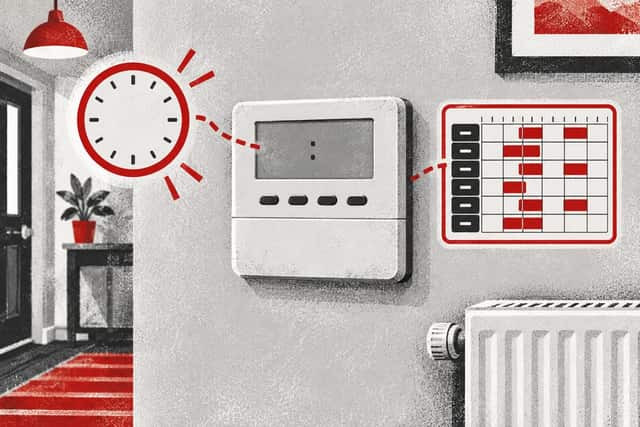
Why does a heating programmer lose only the clock but keep its schedule?
The clock and the schedule may be stored in different ways. A programmer can retain its heating and hot-water periods in non-volatile memory while a separate battery or capacitor maintains the current time during a power interruption. If that timekeeping backup is depleted, the clock may reset even though the programmed periods remain.
Photograph the display and note whether the clock is wrong, blank or asking for the date and time. Check whether the heating periods are genuinely unchanged, whether other appliances lost their clocks and whether the mains supply to the programmer was interrupted. Reset the time only by following the exact model manual. Do not open the programmer, remove it from its wallplate or alter wiring.
The clock and the programme are not necessarily one memory
A heating programmer has two related jobs. Its real-time clock tells it what time and day it is. Its stored programme contains the periods when heating or hot water should be on. Manufacturers can protect those two sets of information differently.
Resideo’s ST9400C guidance is a useful example. It says the real time is maintained by built-in battery backup, while programmes and settings are held in non-volatile memory that does not need power. If the date and time are lost, the guide says it should not be necessary to change the programmes.
That architecture explains the apparently contradictory symptom. It does not prove that every programmer uses the same design, backup duration or warning message, so the model number matters.
What “keeps its schedule” should mean
Look through each day’s switching periods rather than judging from one heating event. A control may have fallen back to a factory schedule that happens to resemble the household routine. A temporary override can also make the system run even when the saved programme is wrong.
Record the heating and hot-water channels separately. Two-channel programmers can retain one set of periods while the user notices only the other channel. Also note the operating mode: AUTO, ONCE, CONTINUOUS and OFF have different effects on many conventional controls.
Energy Saving Trust describes a programmer as the time control that tells heating, and where relevant hot water, when to come on and off. It recommends using the manufacturer’s own manual because control types differ.
A short power interruption is the first clue
The programmer may have lost its mains supply at a fused spur, consumer unit, wiring centre or local circuit. A brief interruption may be enough to expose a weak timekeeping backup even though the stored programme survives indefinitely.
Ask whether microwave clocks, oven clocks or smart devices restarted at the same time. If the programmer display went blank while heating outputs stopped, that is stronger evidence of a supply interruption than a clock that simply drifted.
Do not keep cycling the heating supply to test it. Repeated interruption can obscure the timeline and may affect other controls. If a protective device trips again, there is a burning smell, heat damage or visible loose wiring, stop and use a competent electrician or heating engineer.
The backup component may no longer hold the time
Depending on the product, a battery, rechargeable cell or capacitor may support the clock. Some are designed for user replacement; others are sealed inside the control and are not a homeowner service item.
Resideo’s ST9000 product literature describes a two-level backup arrangement: a battery maintains the date and clock, and a super-capacitor can maintain real time for a limited period if that battery fails. The same literature says programme and parameter settings are stored in non-volatile memory.
An ageing backup can therefore show itself only after a power cut. The programmer may work normally while mains power is present, then forget the current time when power is removed.
Wrong time is different from a failed clock
A clock that is exactly one hour out after the spring or autumn change may indicate a daylight-saving setting rather than failed backup. Many controls change automatically, but the date, region or automatic-change option must be correct.
A clock that gains or loses a few minutes over weeks suggests drift rather than total memory loss. A display asking for the date and time immediately after every interruption points more strongly to backup failure or a product-specific fault.
Write down the size and direction of the error. “One hour slow”, “returned to midnight” and “blank until a button is pressed” lead to different checks.
Check the model before pressing reset
Find the model number on the front, flap or user-accessible label without removing the unit. Download the matching user guide from the manufacturer. Similar-looking controls can use very different reset actions.
A normal time-setting procedure should change only the clock, but a factory reset can restore built-in programmes and erase household settings. Take photographs of every day’s periods, modes and channel states before changing anything.
Drayton’s documentation library, for example, separates user guides and installation guides for the LP range. Use the exact guide rather than instructions copied from a visually similar programmer.
A safe observation sequence
- Photograph the full display before pressing anything.
- Record the model, displayed day, time and operating mode.
- Review the saved periods for each day and channel.
- Note whether heating and hot water currently follow those periods.
- Ask whether there was a power cut, electrical work or a tripped circuit.
- Set only the date and time by the exact user guide.
- Check the display again the next day without interrupting power deliberately.
If the clock remains correct on mains power but resets after the next genuine outage, report that precise pattern. It gives the engineer or manufacturer much better evidence than “the timer keeps forgetting”.
Could the schedule still operate at the wrong time?
Yes. A retained schedule is interpreted against the current clock. If the clock has reset to midnight or the wrong day, the stored periods may still be present but will run at the wrong real-world times.
That can make heating appear to come on randomly or miss the expected morning period. Compare the displayed time with an independent clock when the behaviour occurs.
For a related control symptom, read why a wireless thermostat may reconnect after its schedule starts.
Other controls can make the result look inconsistent
The programmer may send an “on” period while a room thermostat, cylinder thermostat, smart relay or zone valve decides whether heat is actually required. A retained schedule does not guarantee the boiler will fire continuously through that period.
Likewise, a manual override may switch an output until the next programme change. Record indicator lights and the displayed mode rather than using radiator temperature alone as proof of what the programmer commanded.
Do not bridge controls, force valves or enter installer menus to make the boiler run. Those actions can create new faults and remove useful evidence.
When the display itself is the problem
A fading LCD, missing segments or intermittent backlight can make a correct clock look blank. View the display straight on in normal room temperature and photograph it. Do not press or heat the screen.
If the control responds normally and the schedule still operates, a display fault remains possible. If buttons also fail, the whole control may need assessment. Replacement must be compatible with the wiring, system type and required channels.
Do not assume that any programmer will clip onto an existing wallplate safely just because the shape is similar.
What not to do
- Do not remove a mains-powered programmer from its wallplate.
- Do not open the case to look for an internal battery.
- Do not fit a battery unless the user guide identifies it as replaceable.
- Do not factory-reset the control before recording the programme.
- Do not repeatedly isolate power as a test.
- Do not alter boiler wiring or bridge thermostat terminals.
- Do not copy a reset sequence from another model.
When to arrange professional help
Arrange help if the time repeatedly resets, the display blanks while other equipment remains powered, the control becomes hot, the circuit trips, outputs no longer match the display or the programme cannot be checked reliably.
A heating engineer can identify the control and system arrangement; an electrician may be needed for a supply or wiring fault. Internal work on a gas boiler must be completed by a suitably qualified Gas Safe registered engineer. HSE says a gas appliance suspected of being unsafe must not be used until checked.
For rented property, send the landlord or agent photographs, dates and the effect on heating or hot water. Do not remove fixed controls.
What to record for the visit
- Programmer make, model and approximate age.
- The exact clock error or display message.
- Whether saved periods are unchanged for every day.
- Which heating or hot-water channel is affected.
- Any recent power cut, electrical work or tripped circuit.
- Whether the error repeats only after loss of power.
- Operating mode and indicator lights.
- Photographs before and after setting the time.
The practical conclusion
A heating programmer can lose its clock while keeping its schedule because real-time backup and programme storage are separate. Non-volatile memory may preserve on/off periods even when a depleted backup can no longer maintain the clock through an interruption.
Confirm the exact model, check the full schedule, record any power event and follow only the matching time-setting instructions. Avoid opening, rewiring or factory-resetting the control. A repeating loss of time needs product-specific diagnosis.
Heating times no longer reliable?
Keep the display photographs and programme record ready for the visit.