
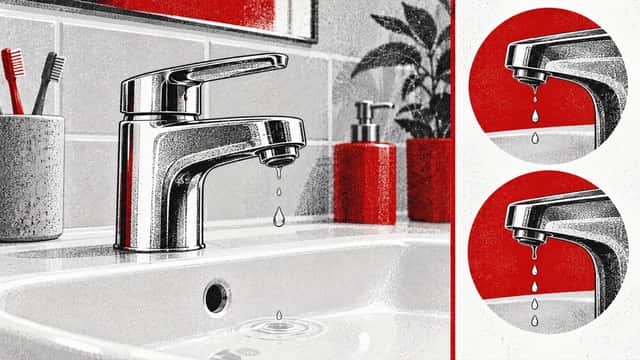
Why does one tap keep dripping briefly after it is closed?
A few drops immediately after a tap is closed can be water already inside the spout, aerator or pull-out spray emptying into the basin. If the dripping continues, restarts later or carries on at a steady interval, the tap may not be sealing fully.
The timing, duration and exact place the water appears are more useful than the word “drip”. Compare the same tap over several uses before assuming the boiler or whole plumbing system is at fault.
The short answer
- Two or three final drops that stop can be residual water leaving the outlet.
- Long, tall, pull-out and spray-head spouts can hold more water.
- A steady drip long after closure points more strongly to a washer, valve or cartridge problem.
- Water around the tap base or beneath the sink is a leak, not harmless after-drip.
- If only one tap is affected, start with that outlet rather than the boiler.
Why a closed tap can still release water
The tap’s internal valve stops new supply water, but it does not make water already downstream of that valve disappear. A small volume remains in the spout and outlet. Air entering through the aerator or spray head can let that water drain in a few separate drops.
The shape of the outlet matters. A high-arched kitchen tap, pull-out hose or large spray head can retain more water than a short basin spout. Surface tension may hold it briefly before gravity wins. That is an explanation for a short, self-ending after-drip—not for water that continues indefinitely.
Use a timed observation
Run the tap normally, close it without forcing the handle and start a timer. Count the drops and note when they stop. Repeat with cold only, hot only and the usual mixed position if the controls allow this easily.
Dry the spout, base, worktop and cupboard first so new moisture is easy to spot. Place a dry sheet of kitchen paper beneath the visible connections, without loosening anything. Check it after the test.
A repeatable cluster of drops immediately after closure is different from one drop every few seconds for several minutes. Record the pattern rather than selecting an arbitrary cut-off that the tap manufacturer has not specified.
Where is the water coming from?
From the end of the spout
This can be retained water or an internal valve that is not sealing. Timing separates the two possibilities. Hansgrohe’s product guidance says a tap that constantly drips after shut-off is commonly affected by limescale or a cartridge defect.
From the base or lever
Moisture around the body, lever cap or worktop is not explained by water emptying from the spout. Stop using the tap if the leak is worsening and arrange a plumbing inspection.
Inside the cupboard
Water on hoses, valves, joints or the cabinet floor needs prompt attention. Do not assume it came from splashing above. If safe, stop using that outlet and tell the property owner or plumber.
Pull-out sprays and detachable heads
A pull-out hose and spray head contain additional water after the valve closes. The head can drain as its angle changes or air enters. Older manufacturer troubleshooting information for some Hansgrohe pull-out models specifically describes dripping for around one to one-and-a-half minutes as the spray head clearing itself.
That statement applies to those designs, not every modern tap. Check the manual for the exact model. A new continuous drip, water from the hose connection or damp inside the cupboard still deserves investigation.
Low-pressure taps are a special case
Some taps are designed for an open-vented undersink water heater and have three hoses rather than the usual two. BLANCO explains that a compatible low-pressure mixer may drip a small amount briefly as the heater deals with expanding water.
Do not block that outlet or replace the tap with a standard high-pressure mixer without checking the water-heater instructions. If you are unsure what is installed, photograph the model labels and ask a competent plumber.
When the seal is probably not closing fully
A ceramic cartridge, traditional washer or internal valve creates the shut-off seal. Wear, debris or limescale can prevent a clean closure. WaterSafe lists damaged or dirty washers, worn cartridges and limescale among common causes of a dripping tap.
Clues include a drip that continues well after the outlet should have emptied, a worsening rate, a handle that feels different or a problem that returns after the spout has been dried. Do not force the handle tighter; that can damage components without improving the seal.
Check the aerator without over-interpreting it
The aerator is the small flow-shaping part at the outlet. Limescale can distort the stream and retain droplets. BLANCO’s care guidance identifies the aerator as a common place for hard-water deposits and recommends product-appropriate cleaning.
Only remove or clean it if the tap instructions make this a user task. Protect the finish, use the recommended method and do not use aggressive chemicals. An aerator may change how remaining water leaves, but it does not repair a cartridge that leaks supply water.
Why one tap can be affected when the others are fine
Each tap has its own spout, cartridge or valves, so one outlet can drip while every other tap behaves normally. A problem limited to one tap usually points first to that tap or its local connections.
Our guide to hot water arriving differently at one tap explains why outlet-specific symptoms should be compared before blaming the boiler. If the drip happens with the boiler switched off or affects cold water too, it is particularly unlikely to be caused by gas-boiler operation.
Could water pressure play a part?
Higher pressure can make an existing weak seal leak more obviously, but a household observation cannot confirm pressure as the root cause. Note whether the symptom began after supply work, a pressure-reducing valve change or other plumbing work, and let a plumber measure if needed.
A bang when the tap closes is a different symptom. Read our guide to a tap banging when turned off for safe evidence to collect about water hammer.
What tenants should do
Report a continuing drip, water beneath the sink or damage to the landlord or managing agent in writing. Include a short video, when it began and whether the hot side, cold side or both are involved. Avoid dismantling a supplied tap without permission.
GOV.UK lists basins, sinks, baths and their pipes among repairs for which a private landlord is generally responsible. Tenancy rules and routes differ across England, Scotland, Wales and Northern Ireland, so use the guidance for your location.
Why a continuing drip matters
A real leak wastes treated water and can stain the basin, encourage limescale deposits or damage a cabinet. WaterSafe’s current advice warns that dripping taps can waste substantial amounts of water and recommends dealing with leaks promptly.
Do not use a headline annual figure to estimate your own loss: the amount depends on the drip rate. A simple timed count or a measured container test gives a plumber more relevant evidence.
When to isolate the water
A few self-ending drops do not call for emergency isolation. If water flows continuously, escapes from a joint, reaches electrics or cannot be contained, act promptly. Know where the internal stop tap is, but do not force a seized valve.
WaterSafe advises turning off the stop tap for a significant internal leak and contacting an approved plumber. If you live in a flat or have a shared supply, contact the building manager or emergency number because the isolation arrangement may not be yours alone.
What not to do
- Do not force the handle closed.
- Do not plug or cap a spout, especially on a low-pressure heater system.
- Do not loosen hoses or cartridges without isolating the correct supply.
- Do not use unapproved sealants inside a drinking-water fitting.
- Do not assume moisture under the sink is harmless after-drip.
- Do not open a boiler casing to investigate an outlet-specific tap problem.
What a plumber will want to know
- The tap make or model if visible.
- Whether it is a standard, pull-out, filtered or low-pressure design.
- How many drops appear and how long they continue.
- Whether hot, cold or both controls cause it.
- Whether water appears at the spout, base, lever or below the sink.
- Any recent plumbing or water-pressure work.
- Whether the flow pattern or handle feel has changed.
The practical conclusion
A tap that releases a few final drops and then stays dry may simply be emptying water held in its outlet. A tap that continues dripping is not closing properly and should be repaired before water and damage accumulate.
Time the symptom, dry and inspect the surrounding area and identify the tap type. Check the exact product instructions, report leaks in rented homes and use an approved plumber when the source is uncertain or dismantling is required.
Hot-water behaviour changed too?
Compare the same outlet on hot and cold, and keep the timing ready for the repair team.