
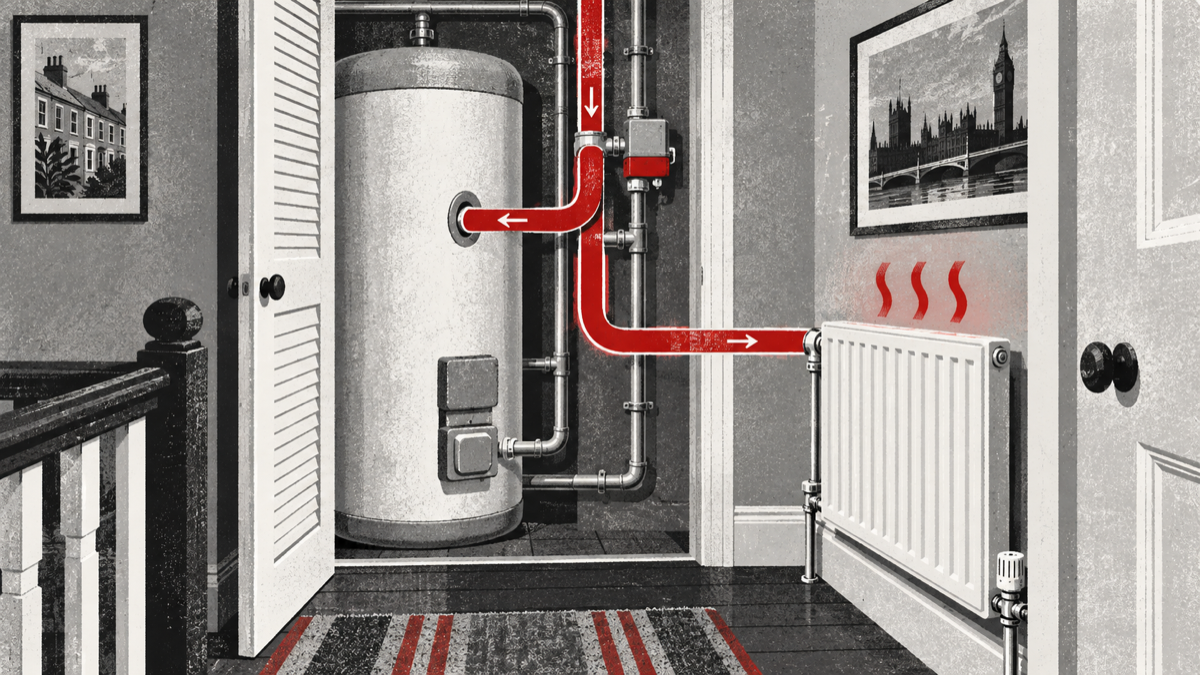
Why does the heating come on while the hot-water cylinder is reheating?
In a home with a hot-water cylinder, the boiler can legitimately heat the cylinder and radiators at the same time if both controls are asking for heat. If the heating channel is off but radiators still become hot whenever the cylinder reheats, water may be reaching the heating circuit when it should not.
The safe way to narrow it down is to check the programmer, room thermostat and timing pattern. Do not move motorised-valve levers, open a wiring centre or remove an actuator.
The short answer
Start with one question: does the control show that central heating and hot water are both on?
If both channels are scheduled and the room thermostat is calling for heat, warm radiators during cylinder reheating can be normal. A three-port mid-position valve can deliberately send boiler water to both circuits. If only hot water is selected and several radiators heat strongly, the valve, controls or system layout may need checking.
How a cylinder system shares boiler heat
A system or regular boiler commonly heats water that is pumped around a closed primary circuit. Controls direct that hot primary water either through the radiators, through the heating coil inside the cylinder, or through both routes.
The tap water stored in the cylinder does not circulate through the radiators. Heat passes from the boiler water through the cylinder coil into the stored water. This distinction matters because warm radiators during a cylinder cycle are about primary-water routing, not hot tap water entering the heating system.
What the programmer and thermostats do
A two-channel programmer can schedule central heating and hot water separately. The room thermostat decides whether the home needs space heating, while the cylinder thermostat detects whether stored water needs more heat.
A time channel being on does not always mean the boiler must fire. The relevant thermostat also needs to be calling, unless the installation uses a different control arrangement. When the cylinder reaches its set temperature, its thermostat should end the hot-water demand.
Check the visible status on the programmer or app. An accidental boost, manual override or overlapping schedule can make both services run even though you expected hot water only.
When both heating and hot water are meant to run
Resideo’s Y-plan guidance shows that a three-port mid-position valve can direct flow to heating only, hot water only, or both. Drayton describes the same principle: when the room and cylinder thermostats are both calling, the valve sits in its middle position and supplies both circuits.
On an S-plan system, separate motorised valves control the radiator and cylinder circuits. Both can be open when both services are requested. Other installations use hot-water priority, where cylinder reheating temporarily pauses or limits space heating before returning to it.
There is no single rule that every cylinder system must follow. The control arrangement, valve layout and commissioning settings determine whether simultaneous heating is expected.
When warm radiators suggest unwanted flow
If the heating channel is clearly off, the room thermostat is not requesting heat and the radiators still warm whenever hot water is scheduled, unwanted flow becomes more likely. Possible causes include a motorised valve that is not closing fully, an actuator or control signal problem, or a system arrangement that intentionally includes a heat-leak radiator.
The pattern matters. One towel rail warming slightly may have a different explanation from every radiator becoming fully hot. Pipe warmth close to the cylinder also does not prove that the entire heating circuit is operating.
Our related guide explains why a radiator may warm when only hot water is selected. This article focuses on deciding whether the controls are deliberately calling for both services during cylinder reheating.
A safe observation check
- Wait for the next normal cylinder-heating period rather than repeatedly forcing a test.
- Photograph the programmer or app showing the hot-water and heating channel status.
- Note the room thermostat setting and whether the room is below that temperature.
- Check whether an advance, boost or holiday override is visible.
- Note which radiators warm, how quickly and whether they become fully hot.
- Record when the cylinder cycle ends and whether radiator warmth stops with it.
Use normal controls only. Do not turn electrical isolators off and on as an experiment, and do not force a valve lever.
Could it be a schedule overlap?
Yes. A morning hot-water period may overlap the first central-heating period by a few minutes. A smart control may also start early to reach the requested room temperature by the scheduled time.
Look at the complete daily schedule, not only the headline setting. If two people manage the app, check for a recent change or temporary boost. Keep a screenshot before altering anything so you can compare behaviour afterwards.
If both channels were genuinely requested, the boiler and pump operating during the overlap may be expected. The useful test is whether heating stops responding once the heating channel is off and the room control is no longer calling.
What is hot-water priority?
Some systems give cylinder reheating priority. During a hot-water demand, the controls may direct most or all available boiler output to the cylinder, then return to space heating when the stored water reaches temperature.
Other systems allow both circuits to operate together. Priority behaviour can also be configured differently on modern controls and heat sources. Do not change installer settings to make the system imitate a different design; that can affect comfort, efficiency and safe operation.
What not to touch
Motorised valves and wiring centres contain electrical connections, and the actuator position does not always tell a homeowner why the system is behaving as it is. A manual lever is generally provided for installation, filling or draining purposes, not as a diagnostic switch for routine use.
Do not remove the actuator, loosen a valve, open a wiring centre or bridge thermostat connections. Do not remove the boiler casing. A competent heating engineer can test the demand signals and actual valve movement without guessing from surface temperature alone.
When should you arrange a check?
Arrange a check if the heating channel is off but several radiators repeatedly become hot throughout every cylinder cycle, the home overheats, the cylinder takes much longer to recover, or hot-water performance has changed. Also seek help if the boiler cycles unusually, a valve is noisy, a circuit trips or a fault code appears.
Give the engineer the programmer screenshots, exact timings and list of affected radiators. Mention whether the behaviour is new, followed controls work or started after a power interruption.
If there is water leaking from a valve or pipe, keep clear of electrical equipment and arrange prompt plumbing help. Gas-boiler work must be completed by an appropriately Gas Safe registered engineer.
The practical conclusion
Heating during cylinder reheating is not automatically a fault. It can be the intended result of both channels calling at once. Check the visible controls, schedules and radiator pattern first. If hot water alone is selected but the heating circuit still receives substantial heat, leave the valve and wiring alone and arrange a controls and circulation diagnosis.
Radiators heating during a cylinder cycle?
Save the control status and timing before arranging a diagnosis.