
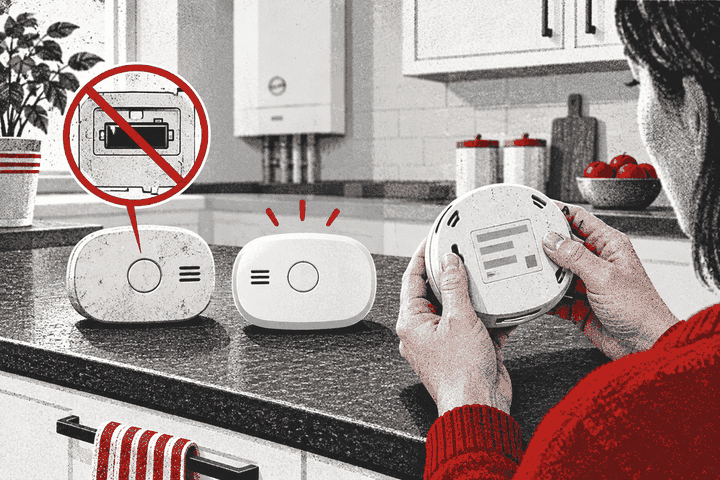
Can a sealed carbon-monoxide alarm battery be replaced?
Usually, no. In a sealed-battery carbon-monoxide alarm, the power cell is built into the unit and is not intended to be removed or replaced by the householder. When that alarm gives a confirmed low-battery or end-of-life warning, the normal remedy is to replace the complete alarm in accordance with its manual. Do not pry the case open or assume that a visible battery-shaped section is user-serviceable.
Read the alarm’s exact model label and manual. If it says sealed lithium, sealed for life, ten-year battery or non-replaceable battery, replace the whole alarm when instructed. A deactivation control on the back may be intended only for disposal after removal, not for resetting the alarm. If it is mains-powered with a sealed backup, use the manufacturer’s replacement instructions and arrange a competent person for wiring or interlinked-system work.
“Sealed” describes the power design
A sealed alarm contains a battery designed to remain inside throughout the product’s intended service life. The case, power system and end-of-life warning are treated as one safety product. It is different from an alarm with a battery drawer or compartment that the manual tells users to open.
Kidde’s K10LLCO and K10LLDCO guide describes the models as powered by a sealed lithium battery and says they enter end-of-unit-life mode ten years after installation. FireAngel guidance likewise distinguishes alarms with replaceable batteries from sealed models that need alarm replacement when the low-battery warning occurs.
“Ten-year battery” does not guarantee ten years from the day you notice the alarm. Storage, activation date, operating conditions and the product’s stated life all matter. Check the installation and replace-by markings.
Why the cell should not be changed
The alarm is certified and tested as a complete device. Opening it can damage the sounder, sensor, circuitry or enclosure and can leave a device that appears present but cannot be relied upon. A household battery with similar voltage or shape is not proof of compatibility.
Sealed designs also prevent ordinary removal of the battery to stop nuisance or maintenance warnings. The correct response is to identify the warning and replace the unit when required, preserving continuous protection.
Do not drill, cut, prise, unscrew or split the case. Do not solder a new cell, bridge contacts or transfer a battery from another alarm. These are not user repairs.
First confirm that the alarm really is sealed
Look for the make, exact model, power statement and user guide. Useful wording includes “sealed lithium battery”, “sealed for life”, “non-replaceable battery” or “10-year battery”. A removable alarm may still have a sealed case even though it slides from a mounting plate.
Do not decide from appearance alone. Some replaceable-battery alarms have closed covers, while some mains-powered alarms include a backup battery or rechargeable cell. A model sold in several power versions can look almost identical.
If the label is on the rear, follow the manual’s normal removal step only if the unit is battery-only and intended for user removal. Do not detach a mains-wired or interlinked alarm, expose conductors or interfere with a landlord’s fixed installation.
Low battery, fault and end of life are different conditions
A chirp does not automatically mean the battery is replaceable. Record the number and spacing of chirps, indicator colour and flash count, display wording and replace-by date. Compare them with the exact model guide.
One model may use one chirp for low battery, two for a fault and three for end of life; another may use different intervals or a display message. Kidde documentation for one current alarm shows distinct visual and audible patterns for low battery, memory fault, CO fault and end of unit life. Those codes should not be copied to another device.
A fault or end-of-life warning may mean the sensor cannot provide dependable detection. Replacing an ordinary battery in a different model, pressing reset repeatedly or waiting for the chirp to stop does not repair an expired or faulty sealed alarm.
What replacement involves
- Identify the exact alarm and read its current user instructions.
- Record the installation or replace-by date, warning pattern and location.
- Obtain a compliant replacement suitable for the room, property and any interlinked system.
- Follow the manufacturer’s placement and activation instructions.
- Use the prescribed test method after installation.
- Write the installation and replacement date where instructed.
- Dispose of the old alarm through the appropriate electrical and battery route.
HSE recommends alarms compliant with BS EN 50291 and says they should be installed and maintained in line with the manufacturer’s instructions. For a rented home, confirm who will supply and fit the replacement before removing the existing protection.
What if it is mounted to the mains?
A mains-powered CO alarm may include a sealed backup battery. The household response is still not to open the alarm or replace internal cells unless the manual expressly provides a user battery compartment. Isolate or alter wiring only through a competent person.
Interlinked alarms can also have compatibility requirements. A replacement that fits the base or powers on may not communicate correctly with the rest of the system. Use the manufacturer’s compatible replacement route and have the system tested as a whole.
If removing one alarm would leave a gap in required protection, plan the replacement so that the gap is as short as possible. Never leave exposed wiring or an empty base accessible.
What a rear deactivation switch means
Some sealed alarms have a switch, tab or pin that permanently deactivates the battery when the unit is being disposed of. It is not a hush button, service reset or way to extend battery life. Once operated, it may make the alarm unusable.
Do not touch such a control until the replacement is ready and the manual says the old unit should be deactivated. Keep it out of children’s reach and follow local disposal guidance for electrical products containing batteries.
If the alarm has activated automatically when attached to its base, do not assume reversing that action restores a used alarm to new condition.
Can a temporary silence feature be used?
Only if the exact manual permits it for the warning you have identified. FireAngel describes Sleep Easy on certain models as an eight-hour silence for low-battery chirps while protection continues, with limits on how many times it can be used. That is time to organise a battery or alarm replacement, not permission to ignore it.
Never use a silence feature during a full carbon-monoxide alarm. Do not tape the button down, muffle the sounder, wrap the device or store it away from the protected room.
If there is no approved temporary step, contact the manufacturer, landlord or responsible installer promptly rather than improvising.
For tenants and landlords
In England, government guidance recommends sealed-for-life batteries where a landlord selects battery-powered CO alarms. It says relevant landlords are responsible for repairing or replacing prescribed alarms found faulty after a tenant report. Tenants are advised to replace ordinary user-replaceable batteries, but should report an alarm they cannot restore or a battery they cannot replace.
A tenant should send the make, model, room, warning pattern, replace-by date, photographs and the time of the report. A landlord should assess it and arrange the correct replacement as soon as reasonably practicable when faulty. Rules and technical requirements differ elsewhere in the UK, so use the guidance for the nation and property.
Do not ask a tenant to open a sealed case. Do not mark the job complete merely because the chirp was silenced. Record the new alarm, installation date and successful prescribed test.
Disposal and recycling
A used sealed alarm contains electrical parts and a battery. Do not put it in a fire, puncture it or leave it where it can be reinstalled. Follow the manufacturer and local council’s route for waste electrical and electronic equipment and batteries.
Some retailers or recycling centres accept small electrical products. Requirements vary locally. Transport the intact unit as instructed and operate any permanent deactivation mechanism only at the stage the manual specifies.
Keep a record of the old model and replacement date before disposal, especially in a rented or managed property.
When this is an emergency instead
A full CO alarm, displayed reading or possible poisoning symptoms are not battery-replacement questions. Go outside into fresh air. NHS lists symptoms including headache, dizziness, nausea or vomiting, weakness, tiredness or confusion, chest or muscle pain, shortness of breath and vision changes.
Get medical advice as soon as possible and do not return until advised. Call NHS 111 for suspected symptoms, and call 999 or go to A&E for serious signs such as breathing difficulty, sudden confusion, loss of consciousness, weakness or chest or muscle pain.
If a gas appliance may be involved, HSE gives the National Gas Emergency Service number as 0800 111 999. Do not open a boiler, adjust combustion equipment or rely on installing a new alarm as a substitute for checking a suspected unsafe appliance.
The practical conclusion
If the manufacturer calls the battery sealed or non-replaceable, replace the alarm rather than the cell. Identify the model and warning, preserve protection while arranging the correct unit, and have mains or interlinked work completed competently.
A sealed alarm is designed to simplify maintenance, not to make warnings optional. Treat low battery, fault and end of life as distinct model-specific conditions, and treat a full alarm or possible symptoms as an emergency.
Related guidance: why a CO alarm may chirp at night and what to record if a CO alarm chirps after a battery change.
Concerned about the boiler as well as the alarm?
Keep the alarm model, warning pattern and any appliance observations ready for the repair team.