
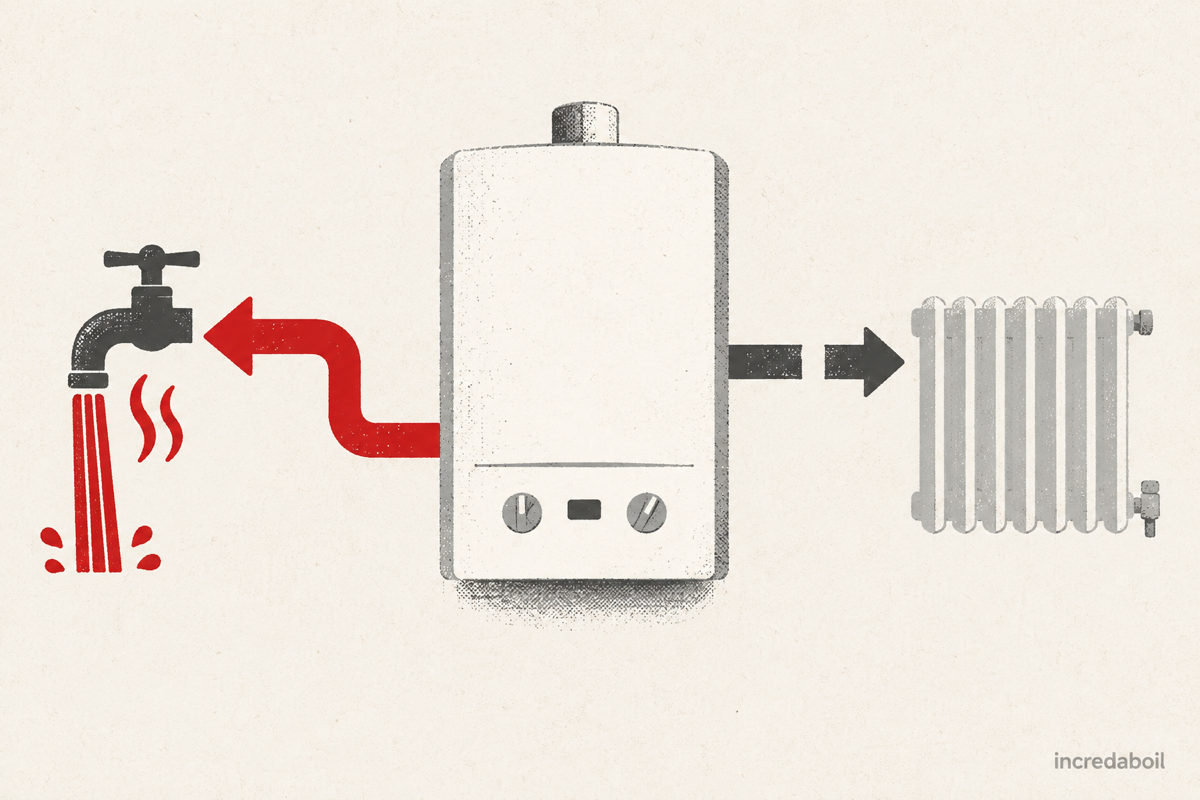
If an Ideal combi boiler produces hot water but the radiators do not heat, begin with heating mode and the external controls. Ideal’s user guides tells homeowners with no central heating to check that mains power is on, make sure the radiator symbol is not crossed out, and confirm that the programmer and room thermostat are calling for heat.
Working hot water shows that the boiler can respond to a tap demand, but central heating has a separate demand path. The problem may be an incorrect mode, schedule or thermostat setting, a lost control signal, low system pressure, poor circulation or an internal changeover fault. Do not remove the boiler case or assume a component from the symptom alone.
First identify the Ideal boiler type
An Ideal combi boiler provides tap water on demand and sends heated system water to the radiators when central heating is requested. Hot water can therefore work even when the room control, heating mode or radiator circuit has a problem.
An Ideal system or heat-only boiler normally works with a hot-water cylinder. If the cylinder heats but the radiators remain cold, the boiler may be operating correctly for the hot-water zone while a separate room thermostat, programmer channel, motorised valve, external pump or heating circuit fails to operate.
Use the model name and its own user guide. Ideal Logic, Logic+, Vogue, Independent and older ranges have different displays and controls. Instructions for one fascia should not be applied by appearance alone.
Check whether central heating is enabled
On applicable Logic Combi2 models, a cross through the radiator symbol means central heating is off. Ideal says to press the Mode button until the cross disappears. Other Ideal boilers use a mode knob or a different menu, so follow the exact operating instructions.
Look for winter or heating mode rather than hot-water-only or summer mode. If someone changed settings for warm weather, the boiler may still serve taps exactly as intended while ignoring radiator demand.
Check the programmer or schedule
Make sure the heating channel is currently on, set to continuous for a brief test or within a programmed period. Check the day, time and any holiday function. Power cuts and seasonal clock changes can leave a programmer following the wrong schedule.
If there are separate heating and hot-water channels, do not use the working hot-water schedule as proof that the heating schedule is also on. They may have different times and outputs.
Turn the room thermostat above the current temperature
Raise the room set point temporarily by a few degrees and look for a heating-demand symbol. A thermostat already satisfied at the chosen temperature will not call for heat. Check battery warnings on a wireless unit and replace batteries only according to its instructions.
If the thermostat says heating is on but the Ideal display remains in standby, the receiver, wireless link, wiring or configuration may be failing to pass the demand. Record what both devices show. Do not open a mains receiver or wiring centre.
Read the Ideal boiler display
Ideal’s current guidance says a plain 0 on applicable displays means the boiler is in standby and is not receiving a demand from hot water or central heating. Logic-family displays may show a central-heating status, a domestic-hot-water status, a crossed radiator symbol, or an F- or L-prefixed fault.
Photograph the complete display before using restart. Include leading zeroes, prefixes and any alternating message. Exact fault meanings vary by model. A boiler that shows heating demand but fails to fire follows a different diagnostic route from one that remains in standby because no demand reaches it.
Check system pressure
For a sealed heating system, read the gauge or digital pressure display when the system is cool. Compare it with the acceptable range in the exact Ideal user guide. Pressure that is too low can stop or interrupt heating and will often produce a message or code.
Only use a clearly identified user filling control if the model instructions permit it and you understand the procedure. Close it fully afterwards. If pressure repeatedly falls, arrange a leak, vessel or safety-valve diagnosis rather than adding fresh water again and again.
Are all radiators cold or only some?
If every radiator is cold, concentrate on heating demand, boiler response, pump and zone or changeover control. If some radiators heat, the boiler is producing and circulating heat somewhere; local valves, trapped air, balancing or branch restrictions become more likely.
A radiator cold at the top often contains air. One hot at the top but cold across the bottom may contain settled debris. One cold all over may have a closed or stuck thermostatic valve, closed lockshield or local blockage. Do not bleed every radiator unless their temperature pattern indicates air, because bleeding can lower system pressure.
Observe what happens when heating is requested
Close hot taps, create a clear room-heating demand and watch the boiler from outside the case. Useful observations include:
- Does the crossed radiator symbol disappear?
- Does the display change from standby to central-heating operation?
- Does a flame or burner indicator appear?
- Does the displayed temperature rise very quickly?
- Do the flow pipes or any radiators begin to warm?
- Does the boiler stop or show a fault?
Tell the engineer exactly what happens. Avoid diagnosing an internal part from noise or touch alone.
What the pattern may suggest
The display remains at 0 or standby
The boiler is probably not receiving a central-heating demand. The engineer will trace the programmer, thermostat, receiver, wiring and configuration rather than beginning with circulation.
The radiator symbol is crossed out
Central heating is disabled at the boiler on applicable models. Use only the normal mode control described in the correct user guide.
Heating status appears but no flame follows
A fault, lockout, pressure condition or another part of the operating sequence may be preventing ignition. Record the complete display for the engineer.
The burner runs but radiators remain cold
The diagnostic focus moves towards circulation, pump operation, valves, trapped air and restrictions. Flow and return temperatures help establish where heat stops moving.
The combi serves hot taps but never changes to heating
The engineer must first prove the control demand and then assess the internal changeover or diverter function.
The cylinder heats but radiators remain cold
On a system or heat-only installation, the separate heating channel, motorised zone valve, external pump and wiring centre become important checks.
Could the diverter valve be the problem?
On a combi boiler, an internal diverter or hydraulic changeover arrangement directs heat according to whether the demand comes from a tap or the radiators. If domestic hot water works consistently but the appliance does not transfer heat to central heating after the tap closes, an internal changeover fault is one possibility.
It is not the only explanation and cannot be confirmed from the symptom alone. The engineer must first verify that central-heating demand actually reaches the boiler. Removing the case, tapping the valve or attempting to move internal parts is unsafe and may damage the appliance.
Could the pump or circulation be at fault?
A pump moves heated system water around the radiators. If it does not run, is airlocked, is incorrectly controlled or faces a severe restriction, the boiler temperature may rise quickly while little heat reaches the rooms. On some installations the pump is inside the boiler; on heat-only systems it may be external.
Note whether accessible pipes warm and whether the boiler cycles or becomes noisy. Do not remove a pump cap, alter internal settings or open the boiler. A competent engineer can test its electrical command, movement and the resistance of the circuit.
Could sludge make the heating fail while hot water works?
Yes, particularly on a combi where tap water uses a plate heat exchanger while the radiators rely on circulation through the wider heating system. Sludge can restrict radiators, valves and pipework without immediately removing all hot-water operation.
Look for several radiators cold at the bottom, dark system water, repeated filter loading, noisy circulation or a large difference between heating flow and return. Those signs support a water-quality investigation; they do not automatically justify one cleaning method. Controls, valves, pump operation and balancing should be checked first.
Should you restart the Ideal boiler?
Use Restart only when the exact Ideal user guide identifies it for the displayed condition. One model-approved restart may clear a temporary lockout, but it does not repair a recurring fault. Photograph the original code first.
If the fault returns, stop restarting and arrange diagnosis. Repeated attempts can remove useful evidence and delay a proper repair. Do not turn the electrical supply on and off repeatedly to force operation.
System and heat-only Ideal boilers need a different view
Where hot water is stored in a cylinder, the boiler may receive separate calls from the hot-water and heating zones. A working cylinder proves that the boiler can fire under one demand. It does not prove that the room thermostat, heating programmer channel, motorised valve or external pump for the radiators is operating.
Record which programmer lights are on, whether the room thermostat clicks or shows demand, and whether a motorised-valve indicator changes. Do not remove valve heads or wiring-centre covers. These circuits include mains electricity and need competent testing.
When to turn the boiler off
Use the normal controls to stop the appliance and seek urgent help if there is uncontrolled leaking near electrics, scorching, a burning smell, severe overheating, a carbon-monoxide alarm or suspected fumes. If you smell gas, avoid electrical switches, ventilate if safe, leave the affected area and call 0800 111 999 from outside or another safe place.
A straightforward loss of heating without danger signs still needs timely repair in cold conditions, especially where children, older people or medically vulnerable occupants depend on the heating.
Information to give the engineer
- The exact Ideal model and whether it is combi, system or heat-only.
- The full display, including mode symbols and any F or L code.
- Whether hot water remains normal at every tap.
- What the room thermostat, programmer and receiver show.
- The cool system-pressure reading.
- Whether every radiator or only some are cold.
- Whether the boiler changes into central-heating status and lights the burner.
- Whether pipes warm before the boiler stops.
- Any recent power cut, control change, system draining or pressure loss.
Common questions
Why does 0 stay on the Ideal display?
On applicable Ideal boilers, 0 means standby with no demand. If you have deliberately requested heating, check mode, schedule, thermostat and receiver. An engineer may need to trace the demand signal.
Why is there a cross through the radiator symbol?
On applicable Logic Combi2 controls it means central heating is disabled. Use the model’s normal Mode control as described in its user guide until heating is enabled.
Does working hot water rule out a boiler fault?
No. It proves that the appliance can respond to one demand, but the heating control input, changeover and circulation functions remain separate diagnostic areas.
Will bleeding radiators restore all heating?
Only if air is restricting circulation. Bleeding cannot repair a programmer, receiver, diverter, zone valve or failed pump and can lower sealed-system pressure.
Related boiler-help guides
- Thermostat says heating is on but boiler is not firing
- Boiler is running but radiators are not heating: what now?
- Radiator not working? Work out what the cold patch means
- Why is my thermostat not communicating with my boiler?
Hot water but no heating from your Ideal?
Book a fixed-price boiler diagnosis and repair in Leeds when the taps are hot but the radiators remain cold.