
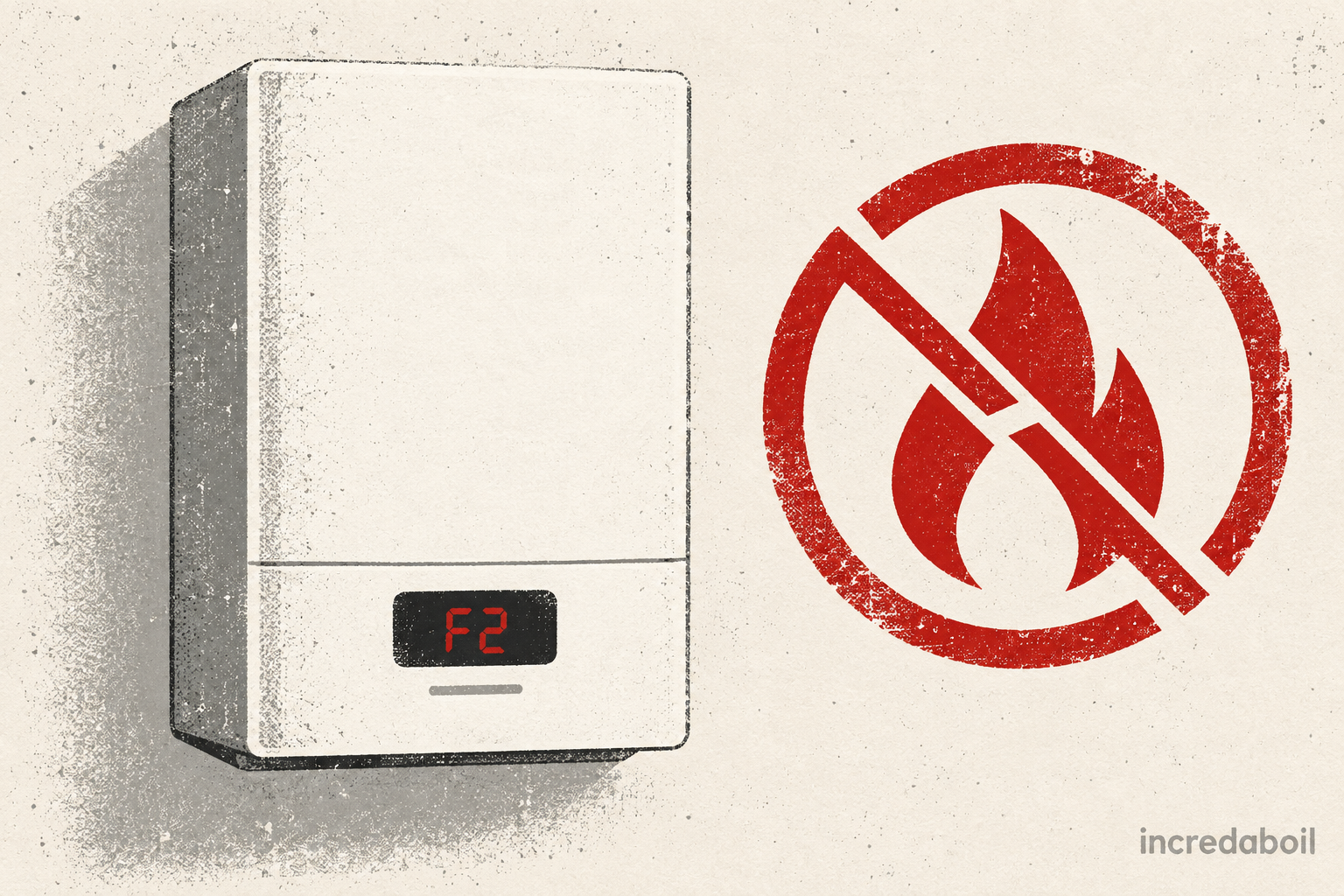
An Ideal F2 fault code means flame loss on the Ideal boiler models covered by the manufacturer guides referenced below. The boiler has not been able to maintain a detected flame, so it stops operating rather than continuing unsafely. A simple interruption to the property’s gas supply is one possibility, but an F2 code can also need professional diagnosis inside the appliance.
This guide explains what the code means, the limited checks a homeowner can make safely and when to stop. Fault-code wording and controls can vary between Ideal ranges, so identify the exact boiler model and use its own user guide before pressing buttons or changing settings.
What does F2 mean on an Ideal boiler?
Ideal’s current Exclusive2 user guide and its Logic Combi ESP1 guide both describe F2 as flame loss. In plain English, the boiler’s controls are not receiving the flame confirmation needed to continue running. The appliance therefore shuts down or enters a fault condition.
“Flame loss” is a description of what the boiler detected, not a complete diagnosis of why it happened. The display alone cannot tell a homeowner which component is responsible. That distinction matters because online lists often present one supposed cause as certain, when several very different conditions can lead to the same end result.
Do not confuse F2 with every other Ideal ignition-related code. For example, some Ideal guides describe L2 as ignition lockout. The exact letters and numbers shown, the model name and when the fault appears are all useful details for an engineer.
What should you check first?
Ideal’s user guidance for F2 starts with the gas supply to the property. These are observation-only checks; they do not require the boiler casing to be opened.
- Write down the exact code. Check that the display genuinely reads F2, not F1, F3 or L2. A photograph is useful.
- Identify the boiler. Record the Ideal range and model from the visible label or paperwork. Do not remove the casing to look for it.
- Check whether other gas appliances work. If you have another gas appliance and it is safe to operate normally, see whether it also appears to have lost its supply. Do not repeatedly try to light an appliance.
- Check the meter situation. If you use a prepayment meter, confirm it has credit. If you know how to view your normal meter display, check that it is not reporting a supply issue. Do not dismantle, force or bypass any meter control.
- Consider local supply information. A neighbourhood interruption or recently restored supply can affect more than one appliance. Contact your gas supplier or network operator if the property appears to have no gas.
If other gas appliances work normally, that does not prove the boiler is safe or identify the fault. It only makes a whole-property supply interruption less likely. The next stage belongs to a suitably qualified Gas Safe registered engineer.
Should I reset an Ideal boiler showing F2?
Use only the restart or reset procedure printed in the user guide for your exact model. Ideal controls differ between ranges. If the guide permits a homeowner restart, one careful attempt can show whether the fault was temporary. If the F2 code returns, the boiler fails to run, or the guide tells you to contact Ideal or an engineer, stop there.
Repeated resets are not a repair. They can hide the pattern that helps an engineer diagnose the problem, and they do not correct an unreliable flame or gas-supply issue. Never keep cycling the electrical supply, pressing controls or trying different internal-looking menus in the hope that the boiler will eventually remain on.
Do not reset at all if you smell gas, suspect carbon monoxide, see soot or staining, hear an unusual combustion noise, or believe the appliance may be unsafe. Follow the emergency guidance below instead.
Why might an F2 fault happen?
The safe answer is that the cause needs testing. Depending on the exact boiler and circumstances, an engineer may need to investigate the incoming gas supply, ignition and flame-detection system, combustion components, condensate route, electrical connections or another appliance condition. Those checks can involve gas pressures, combustion analysis and access behind the boiler casing.
They are not suitable DIY jobs. Buying a part from a fault-code list is especially risky: the same displayed outcome can have more than one cause, and replacing an unproven component may waste money without making the appliance safe.
A property-wide gas interruption
If every gas appliance has stopped working, the problem may be outside the boiler. A prepayment balance, meter issue, supplier interruption or network problem may need resolving first. Follow your supplier’s instructions. Do not attempt to purge gas pipework or relight appliances contrary to their user guides.
A boiler-specific fault
If another gas appliance works but the Ideal boiler shows F2, the boiler still needs a proper assessment. Tell the engineer whether the code appeared during heating, while a hot tap was running, after a service, after a power cut, or intermittently. Also mention any unusual noise or whether the fault returns immediately after the manufacturer-approved restart.
Cold-weather context
Freezing weather can create condensate problems on some installations, but an F2 code should not automatically be blamed on a frozen pipe. Look only at pipework that is visible and safely accessible from ground level. Do not climb, dismantle boiler parts or pour boiling water over plastic pipework. Use the exact manufacturer’s cold-weather guidance for your model or arrange an engineer.
F2, F1 and L2 are not the same code
Accurate identification prevents the wrong advice being followed:
- F2: described by the cited Ideal guides as flame loss.
- F1: described in the same guides as low water pressure.
- L2: described on relevant Ideal models as ignition lockout.
That does not mean every Ideal boiler ever made uses precisely the same code set. Keep the user guide supplied with the appliance or download the correct guide from Ideal using the model details. Advice for a different range may show different controls or actions.
When is an F2 code an emergency?
An F2 display by itself usually means the boiler has stopped because it detected a fault. Treat the situation as a gas emergency if you smell gas or suspect an escape. HSE guidance says to call the National Gas Emergency Service on 0800 111 999, open doors and windows, and shut off the gas at the meter control valve if you know how to do so safely. Avoid flames, smoking and operating electrical switches in the affected area.
Carbon monoxide cannot be seen, tasted or smelled. Possible symptoms include headache, dizziness, breathlessness, nausea, tiredness, chest or stomach pain, visual problems, unusual behaviour and loss of consciousness. If a carbon monoxide alarm sounds, or people become unwell and exposure may be involved, leave the property for fresh air, seek urgent medical help and follow emergency advice. Do not use the boiler again until it has been checked.
Other warning signs such as soot, yellow or brown staining, or a concern about the flue also justify switching the appliance off and obtaining professional advice. A carbon monoxide alarm is an important precaution, but it does not replace maintenance and safety checks.
Who can repair an Ideal F2 fault?
HSE states that anyone employed to work on a domestic gas appliance must be Gas Safe registered and competent in that area of gas work. Ask to see the engineer’s Gas Safe ID card and check the categories on the back if you are unsure.
Keep the boiler casing closed. The casing can form part of the appliance’s safety arrangement, and internal work may involve gas, combustion, electrical and flue checks. A competent engineer can test rather than guess, identify the reason for the lost flame signal and explain the appropriate repair
What information will help the engineer?
- a clear photograph of the F2 display;
- the full Ideal model name;
- whether heating, hot water or both were requested;
- whether other gas appliances work normally;
- whether the property uses a prepayment meter and has credit;
- when the fault began and whether it is intermittent;
- what happened after one user-guide-approved restart, if attempted;
- any recent service, repair, power cut or local gas interruption;
- any smell, alarm, soot, staining or unusual sound.
This information does not replace testing, but it gives the engineer a useful starting point and helps distinguish a property supply problem from a boiler-specific failure.
Can servicing prevent an F2 fault?
No service can guarantee that a boiler will never develop a fault. Regular maintenance can, however, give a Gas Safe registered engineer an opportunity to inspect the appliance, check safety and identify deterioration. HSE strongly advises that gas appliances, flues and pipework are regularly maintained and serviced at least annually.
Servicing should not be presented as proof that a particular F2 event would have been prevented. Components can fail between visits and external supply interruptions can occur without warning. The immediate task is to deal with the present fault safely and establish its cause.
Frequently asked questions
Does F2 mean my Ideal boiler needs replacing?
No. F2 reports flame loss; it does not decide whether repair or replacement is best. That judgment depends on the diagnosed cause, the boiler’s age and condition, parts availability, repair cost and any wider safety findings.
Can low boiler pressure cause F2?
Do not assume so from the display. In the cited Ideal guides, low water pressure is listed separately as F1, while F2 is flame loss. Record the pressure only if the gauge is clearly visible, but follow the exact model guide and let an engineer diagnose conflicting symptoms.
Why does F2 return after a reset?
A reset asks the boiler to try operating again; it does not repair the cause of flame loss. A returning code indicates that further professional checks are needed. Stop repeating the reset.
Can I remove the casing to look for a loose wire?
No. Do not open the boiler or disturb gas, combustion, electrical or flue components. Arrange a suitably qualified Gas Safe registered engineer.
Will an F2 fault affect both heating and hot water?
On a combi boiler, a flame-loss fault can prevent the burner providing either service while the appliance is locked out. The exact behaviour depends on the model and system type. Tell the engineer what was being requested when the code appeared.
Related boiler-help guides
- Ideal L2 fault code explained
- Ideal F1 fault code explained
- Boiler not firing up: safe checks
- Boiler smells unusual: when to act
Is your Ideal boiler still showing F2?
Book a fixed-price Incredaboil boiler repair and have the flame-loss fault tested by a qualified engineer.